

Key Takeaways
- Both options deliver dependable deep foundations across varied soil conditions and project scales.
- Ground screws offer faster installation with minimal disturbance, making them ideal for access-limited sites.
- Helical piles provide higher bearing capacity and consistent performance in challenging soils.
- Everstar’s specialized equipment ensures precise installation and stable torque control.
- Selecting the best system depends on soil type, load, access, and long-term support expectations.
When evaluating foundation plans, engineers often compare the behavior of ground screws and helical piles under different soil conditions and installation constraints. Although the systems appear similar at first glance, the performance gap becomes clear when torque response, depth, and site access are considered.
Everstar’s tool lineup supports site-specific foundations, especially where traditional methods create delays or excessive disturbance.
Both systems deliver significant value across building projects, from small cabins to more complex construction, and the choice between screw piles and helical piles directly shapes overall stability, cost, and long-term reliability.
Technology Overview and Installation Process
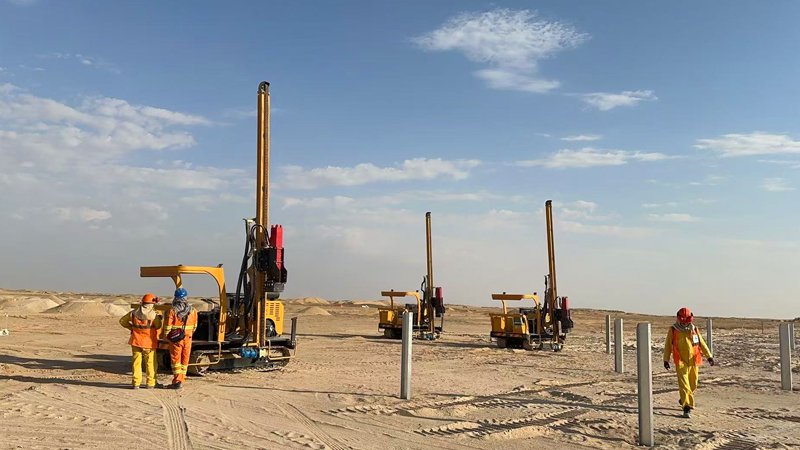
Understanding the installation process is essential to differentiating these foundation systems. Both rely on torque and embedment, but each interacts with soil type in distinct ways.
Ground Screw Fundamentals
A ground screw works like a large steel fastener driven into the ground with controlled torque. Its threading grips the soil, forming friction and a stable connection even when the ground level varies.
These systems demonstrate impressive speed in soft soil, without the need for concrete pouring, and with reduced disturbance to the surrounding area.
They perform well with wooden beams, modular structures, and temporary installations, delivering notable load bearing capacity when the soil is uniform. In many municipal projects, teams use ground screw anchors to improve lateral stability without large excavation.
Helical Pile Fundamentals
Helical piles use a central shaft with helix plates that advance through soil via rotational force. This geometry enhances bearing capacity, particularly when deeper embedment is required.
These piles excel in mixed soils, gravel, and when approaching rock layers, where predictable torque feedback is crucial.
Because helical pile installation relies on torque monitoring, crews can determine capacity in real time, improving design accuracy. These systems are also referred to as helical piers in retrofit work or reinforcement of existing structures.
Installation Equipment and Techniques
Everstar’s equipment provides precise installation, stable torque delivery, and controlled rotation, features that prevent settlement-related issues years later.
It’s important to note that Everstar machines are not intended for large-scale construction, but they are ideal for small- to mid-size projects that require accuracy.
The tools allow crews to install helical piles and screw piles without large rigs or extensive pits, making them suitable for sites requiring minimal disturbance. This approach aligns with safe installation practices emphasized by OSHA.
Performance, Cost, and Suitability
Choosing between a ground screw and a helical pile depends on load, soil behavior, and practicality.
Load Bearing and Settlement
In static and dynamic tests, helical piles consistently deliver higher bearing capacity, especially at deeper depth. A single pile often provides more stability than groups of shallow alternatives. These piles are well-suited for deep foundations, decks, and heavier structures.
Ground screws perform strongly in uniform soils with predictable behavior. Their stability remains reliable when the soil is compact, and their several advantages make them ideal for modular or temporary structures.
Everstar’s torque records show solid performance even in moderate soft soil conditions.
Project Suitability and Cost
In predictable soil, ground screw anchors offer a genuinely cost-effective solution by reducing labor hours and eliminating curing time.
Helical piles become the preferred choice when a project presents unique challenges, such as steep slopes, inconsistent weather conditions, or restricted access. For demanding pile foundation, they outperform traditional methods that rely heavily on concrete and additional curing delays.
Everstar consistently recommends evaluating site conditions, torque profiles, and soil sampling early in the process. This step helps select the right system based on different project requirements.
Sustainability and Long-Term Support

Sustainability plays a measurable role in materials selection, soil disturbance, and long-term use.
Environmental Impact Comparison
Screw piles offer significant environmental advantages due to their removability and reuse. They eliminate concrete curing and create minimal environmental impact, making them well suited to modern construction that demands minimal disruption to the surrounding environment.
Helical piles also reduce environmental impact compared to traditional footing systems, though they require thicker steel for structural support. Both solutions comply with industry standards and modern building codes.
Maintenance and Lifespan
Both systems offer long service life when properly installed. Everstar recommends periodic inspections, corrosion checks, torque verification, and structural monitoring.
When these guidelines are followed, both screw piles and helical piles maintain their performance across decades.
FAQ – Foundation Piles Comparisson
Do ground screws or helical piles work better in sand?
Both options can work well in sandy soils, but performance depends heavily on compaction and embedment depth. Helical piles generally achieve higher stability since larger helix plates engage the soil more efficiently. Ground screws may be suitable for moderate loads where the upper layers provide enough cohesion for torque transfer.
Which system is faster to install?
Ground screws are usually the fastest option, particularly in restricted access areas or when quick assembly is required. They eliminate curing delays entirely. Helical piles require more time due to deeper embedment and torque control, though the process remains faster than concrete foundations and traditional excavation methods.
What are key maintenance needs for each?
Both systems require routine inspections, focusing on corrosion checks, torque loss, and soil movement. Helical piles may require closer attention to the shaft and helix plates, while ground screws require checking thread integrity and coating condition. With periodic monitoring, both systems provide long-term reliability with minimal intervention.
Conclusion: Selecting the Optimal Foundation Technology
The most effective choice aligns with soil conditions, expected loads, and access limitations. Screw piles deliver speed, flexibility, and great benefits in predictable soils, while helical piles provide deeper performance and higher capacity for complex engineering challenges.
Everstar offers soil evaluation, torque monitoring, and equipment guidance to help teams determine the best path for each next project.
Book an Everstar Consultancy for your Building Project
To ensure your foundation begins on solid ground, schedule an on-site evaluation with Everstar specialists.
The team analyzes soil conditions, torque profiles, and structural needs to design the optimal pile foundation strategy. Support structures installed with precision start with expert assessment.

