
Key Takeaways
- Breakout force rates the front loader; digging force rates the rear excavator used for trenching.
- EVERSTAR’s E3CXL and E4CX list 4000 mm digging depth retracted; 5200 and 5300 mm are extended readings.
- The E4CX has less rated power (75 kW vs. 85 kW) yet 46 kN of digging force against 36 kN.
- Backhoe weight and overall dimensions set trailer, road, and soft-ground limits.
- Soil, operator skill, bucket choice, and attachments change real output on the job site.
A buyer holds two backhoe loader data sheets with near-identical specifications, yet on the job site, one backhoe efficiently fills trucks all day while the other struggles and stalls in clay at the bottom of a utility trench. Although the figures on the spec sheets were accurate, the key difference was that nobody had asked how each measurement was taken or what the numbers truly meant in real-world conditions.
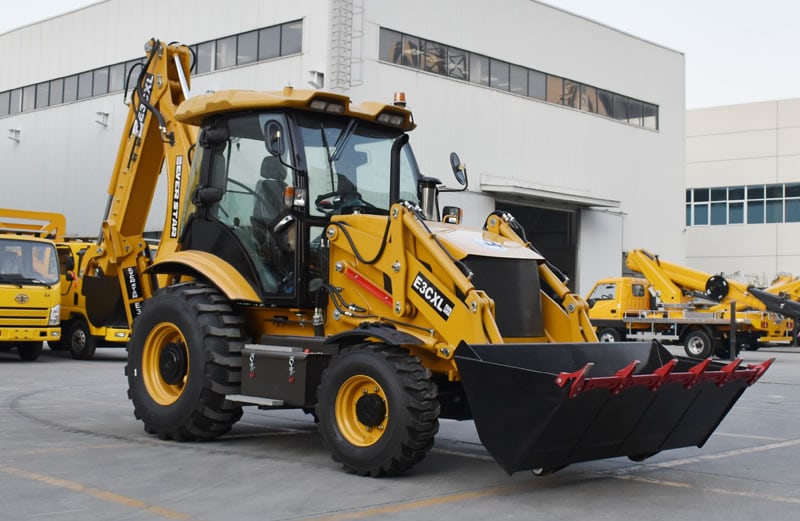
This article guides you on how to read and interpret backhoe loader specifications effectively, using EVERSTAR’s E3CXL and E4CX models as practical examples to highlight critical differences.
How Backhoe Loader Specs Are Measured and Where Sheets Differ
Two backhoe manufacturers can print the same label using a different stick position, bucket size, or test method, so confirm how each rating was taken before any comparison of key features.
Ask four questions: is the depth figure retracted or extended, which test method produced the excavator force rating, is lift capacity rated at full reach, and does machine weight include fuel, operator, and attachments?
Digging Depth and Reach: Standard and Extended Readings on a Spec Sheet
Depth is the most misread figure on any backhoe sheet. EVERSTAR lists the excavator’s maximum telescopic digging depth as two values: 4000/5200 mm on the E3CXL and 4000/5300 mm on the E4CX.
The first value is the standard reading, stick retracted, so the headline 5200 mm and 5300 mm figures are both extended readings.
Boom geometry and the telescopic arm set excavator reach with the same split: maximum digging radius runs 4800/6000 mm on the E3CXL and 5700/6500 mm on the E4CX. Confirm the telescopic arm is in the configuration quoted before comparing.
Breakout Force and Digging Force: Two Hydraulic System Ratings for Two Ends of the Machine
Breakout force belongs to the front loader. It measures force at the front bucket edge as the loader curls into a pile, setting the pace for moving materials.
Both EVERSTAR backhoe loader models rate 72 kN, with a 1 m³ loader bucket on the E3CXL and a 1.2 m³ one on the E4CX. Loader capacity and bucket capacity set the passes per load. At the front end, loader lift capacity commonly falls in the 6,500 to 13,000 lb range.
Digging force belongs to the rear excavator: the E3CXL rates 36 kN and the E4CX rates 46 kN. That 28% gap decides whether the excavator keeps digging trenches through hard clay, even with 0.3 m³ backhoe buckets on both.
Ask whether a sheet rates digging force at the bucket or stick cylinders, since the two figures differ. A backhoe needs both digging and loading strength: compare breakout force for loading and digging force for trenching and excavation at the other end.
Reading Power and Weight Figures Against Real Site Constraints
Horsepower and Travel Speed: What 85 kW and 75 kW Mean Across a Work Cycle
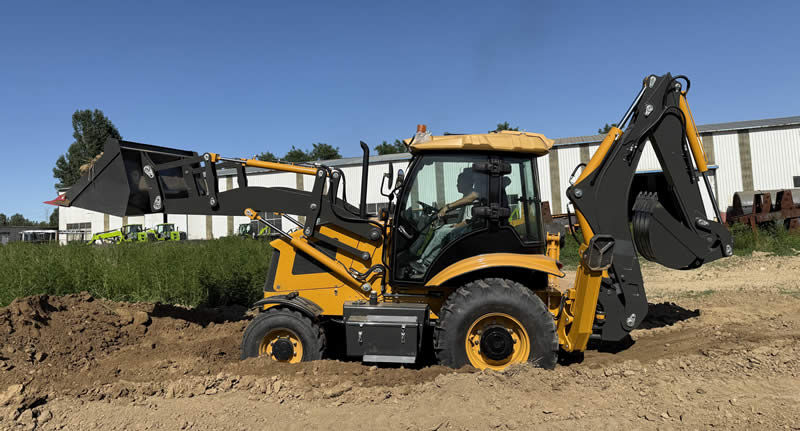
The E3CXL runs a turbocharged Yuchai engine rated 85 kW (114 HP), traveling up to 40 km/h (25 mph). The E4CX carries a turbocharged Yuchai rated 75 kW (101 HP), with a 38 km/h (24 mph) top speed. Each backhoe drives all four wheels through a fixed-axis powershift transmission, though common layouts also include power shuttle, power shift, and hydrostatic.
Higher kW speeds road travel and loaded cycles. The E4CX delivers more digging force from less engine output because its hydraulic system pressure is rated 28, against 19 on the E3CXL.
Auxiliary hydraulics set attachment versatility, deciding which attachments a backhoe loader can run. Hydraulic breakers, augers, and compactors share the hydraulic system that drives the excavator boom, so confirm auxiliary flow before ordering attachments. Forks and specialized buckets can also extend material-handling options beyond standard digging.
At 38 to 40 km/h, either backhoe loader drives on its own wheels between nearby sites. Rated kW says little about fuel efficiency or service intervals, so ask for consumption at typical load.
Operating Weight and Dimensions: Trailer, Road, and Site Access Limits
Backhoe size and weight decide the trailer. The E3CXL weighs 7300 to 8000 kg (16,100 to 17,600 lb) depending on configuration; the E4CX weighs 9500 kg (20,900 lb) before attachments.
Overall dimensions are 6150 × 2350 × 3760 mm for the E3CXL, the more compact machine, and 6500 × 2500 × 3800 mm for the E4CX. Both widths sit under the 102 in (2.6 m) federal standard.
The transport risk is vertical: either backhoe loader on a trailer deck can exceed the 13.5 to 14.5 ft limits many states set. Check axle loads and permits with the U.S. Department of Transportation.
On soft ground, read mass against tires; the catalog lists no ground pressure. The E4CX spreads 9500 kg over larger 16.9-28 tires with 450 mm ground clearance; the E3CXL runs 14-17.5 front and 19.5L-24 rear tires with 300 mm.
The E4CX turns in a 4200 mm radius against 6580 mm on the E3CXL, giving the larger backhoe loader an edge in tight spaces.
Using the Spec Sheet to Choose a Class and Model
Class and Model Fit: Matching a Specification Profile to the Job
A backhoe loader is a versatile machine designed to handle both digging and loading, while a dedicated excavator is designed primarily for excavation. Understanding the main factors behind the E3CXL versus E4CX choice comes down to which backhoe functions the machine will perform most often and the scale of the projects.
| Application | Rating to check first | E3CXL | E4CX | Stronger fit |
|---|---|---|---|---|
| Utility trenching | Excavator force, extended digging depth | 36 kN, 5200 mm | 46 kN, 5300 mm | E4CX in hard ground |
| Drainage | Digging radius for spoil reach | 6000 mm | 6500 mm | E4CX on long runs |
| Loading trucks | Dump height, loader bucket capacity | 2650 mm, 1 m³ | 2800 mm, 1.2 m³ | E4CX |
| Mixed work and grading | Travel speed, rated kW, machine mass | 40 km/h, 85 kW, 7300-8000 kg | 38 km/h, 75 kW, 9500 kg | E3CXL |
In loose soil, contractors find the lighter E3CXL backhoe a strong fit for utility work, drainage, backfill grading, and frequent moves on its own wheels. Where digging trenches in compacted ground or loading trucks is the main task, the E4CX’s digging force, larger front bucket, and higher dump point justify its extra mass, while heavy-duty backhoe loaders can also handle robust loading and cleanup with gravel and concrete debris.
When matching class and model to the work, the front loader usually handles grading and backfilling while the rear boom handles digging. Large-scale excavation beyond 5300 mm needs a dedicated excavator, and very confined footprints may suit mini excavators.
FAQs — Backhoe Loader
What is the difference between breakout force and digging force on an EVERSTAR backhoe loader?
Breakout force rates the front loader; digging force rates the rear excavator. Both models rate 72 kN at the loader, with digging force at 36 kN (E3CXL) and 46 kN (E4CX). Use breakout force for loading compacted piles and digging force for hard-ground excavation.
Which backhoe loader rating should I check first when comparing models for utility trenching?
Check rear excavator digging force first, then extended digging depth. Digging force decides whether the backhoe cuts through compacted fill and clay; depth decides whether the excavator boom reaches the service line. The E4CX’s 46 kN suits hard ground, and the E3CXL’s 36 kN covers looser soil.
Contact EVERSTAR for Confirmed Backhoe Loader Data and Model Selection
Construction contractors and fleet buyers can contact EVERSTAR Machinery for E3CXL and E4CX backhoe data sheets with confirmed specifications, lift capacity charts, and attachment options.

