
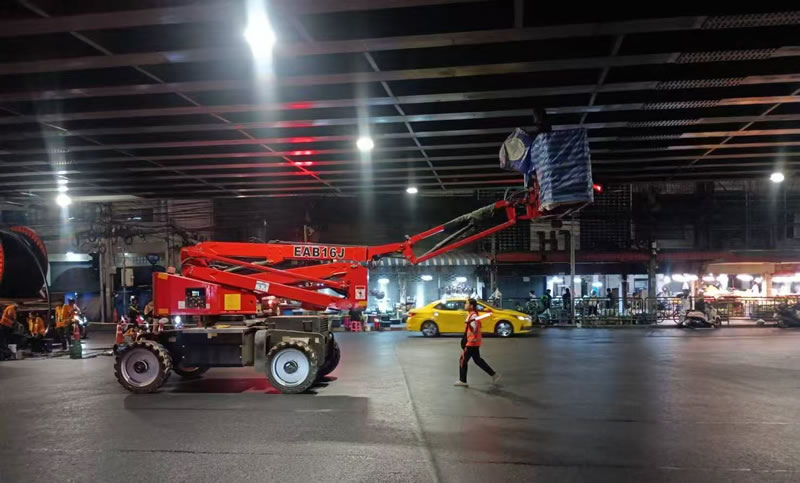
Key Takeaways
- Bearing pressure at each outrigger pad must be calculated before operators extend the boom lift and must fall within confirmed load capacity at the location.
- Outrigger pad area controls bearing pressure; compare outrigger load data across boom lift models before selecting equipment for any deployment location.
- OSHA 1926.453 requires a competent person site assessment before deploying any aerial work platform.
- EVERSTAR diesel and electric articulating boom lift models cover platform heights from 16 to 47 meters and capacities from 200 to 480 kg.
Articulating boom lifts are engineered for construction projects, maintenance, window washing, painting, sign installation, and access to hard to reach areas, elevated work areas, and confined areas where ladders are not viable.
Across industries from construction to electrical work and lighting installation, the benefits include compact design, exceptional reach, and precise positioning.
EVERSTAR, one of the leading manufacturers of diesel and electric articulating boom lift models, offers an extensive selection with four wheel drive options for outdoor terrain and indoor electric models where gas is restricted.
Ground Bearing Pressure: How an Articulating Boom Lift Transfers Load to the Site
Every articulating boom lift concentrates its full operating weight at the outrigger contact points; boom lift models with greater horizontal outreach generate larger outrigger loads, and equipment selection must be evaluated against site conditions before workers extend the boom lift.
EVERSTAR diesel articulating boom lift models cover platform heights from 16 to 47 meters for outdoor construction and maintenance; electric models cover 12 to 28 meters for indoor maintenance and building access where gas is not available.
Identifying Site Hazards: The Pre-Deployment Assessment
The site assessment must be completed before the aerial platform is dispatched. It covers surface condition indicators, underground hazard identification, and clearance constraints that affect articulating boom lift access and operation.
Visual Ground Condition Indicators: What to Check Before Deployment
Saturation indicators, including surface moisture and soft spots, reduce bearing capacity across the footprint, allowing less margin for safe outrigger loading on the footprint.
Evidence of recent disturbance signals capacity may be lower than surrounding terrain. Rutting from previous diesel equipment operation indicates capacity may be below the threshold for the planned articulating boom lift model. Rental fleets or boom lifts for rent can add flexibility when site conditions change and a different model is needed.
Proximity to drainage channels or foundation edges creates additional settlement risk. OSHA 1926.453 (Occupational Safety and Health Administration) requires a competent person to assess site conditions before any aerial work platform is deployed.
Underground Hazard Identification: Utilities, Voids, and Subsurface Features
Subsurface hazards cannot be detected by surface observation alone. Underground utility trenches, drainage structures, vault roofs beneath paved surfaces, and legacy infrastructure on brownfield sites reduce effective load capacity.
These features appear in industrial facilities, buildings undergoing repairs and electrical maintenance, and urban construction locations.
Overhead clearance constraints, including power lines, structural beams, and building facades, must be mapped before the machine arrives to confirm which boom lift models can operate at the location and platform heights.
Outrigger Pad Selection, Cribbing, and Stabilizer Configuration
After the site assessment, outrigger pad selection is the primary variable to bring bearing pressure within confirmed terrain capacity.
Larger pad area distributes the boom lift load across a greater contact surface. Compare boom lift models and outrigger capabilities before dispatching equipment; confirm site access before workers extend the boom lift.
Outrigger Pad Sizing: How Pad Area Reduces Bearing Pressure
Minimum pad area equals the outrigger load at maximum extension divided by the confirmed terrain capacity at that position.
Rubber pads suit hard surfaces; timber cribbing suits soft terrain where rubber pads would compress unevenly and where precise positioning of the load distribution is required.
Boom lift models with higher platform heights generate greater outrigger loads on soft terrain;telescopic boom lifts also typically provide greater maximum height and outreach than articulating boom lifts, and outrigger load data determines deployability without additional accessories.
At locations where obstacles or buildings limit clearance, compare boom lift capabilities, horizontal outreach range, and whether a rotating jib improves maneuverability before confirming the deployment site.
Maintenance and repair teams working inside buildings should compare indoor boom lift models against outdoor diesel and gas alternatives to match platform access to the location, as certain units are designed for these conditions and are ideal where controlled access and maneuverability matter.
Deployment Verification: Confirming Stabilizer Performance Before Platform Extension
Leveling within manufacturer tolerances is the first step after outrigger pads are positioned; level confirmation must be completed at the machine control panel before any boom operation begins, and stabilizer setup must meet manufacturer tolerances before extension begins.
Visual confirmation that each pad bears evenly without edge loading must be completed before workers board the platform; edge loading concentrates machine weight at one side of the pad, reducing effective contact area and increasing pressure beyond calculated values.
Uneven or continuing settlement requires operators to retract the boom lift and reassess before extending further. The ability to extend the boom lift past obstacles and access elevated areas depends on completing this verification at every site for ease over uneven conditions, and it can reduce equipment repositioning and setup time by up to 25% compared with scaffolding.
FAQs — Boom Lift: Ground Pressure and Site Deployment
How do I calculate ground bearing pressure for an articulating boom lift?
Divide the maximum outrigger load at full extension by the effective contact area of the outrigger pad; the result in PSF must fall below confirmed terrain capacity at that location. EVERSTAR provides outrigger load data with each boom lift model so site managers can compare machine configurations and confirm platform heights for the planned location. Whether the work involves painting, window washing, or maintenance, the bearing pressure calculation process is the same.
What size outrigger pads are needed to deploy a boom lift on soft ground?
Minimum pad area equals the outrigger load divided by the confirmed bearing capacity of the terrain. On soft terrain with capacity of 500 to 1,000 PSF, requirements are significantly larger than on firm gravel or asphalt. Timber cribbing is the standard solution. Compare diesel and electric boom lift models, horizontal outreach, and outrigger load data when assessing clearance around obstacles at the location.
Ground Pressure Assessment Keeps Operations Safe
Ground pressure planning covers terrain identification, hazard assessment, bearing pressure calculation, outrigger pad selection, leveling confirmation, and extension monitoring to confirm the boom lift can extend to the required platform heights.
Construction site managers and maintenance contractors who compare boom lift models and complete this sequence reduce costs, avoid downtime, and protect workers.
EVERSTAR diesel and electric articulating boom lift models cover platform heights, horizontal outreach, and capacity range for construction, repairs, and industrial applications across multiple industries.
Contact EVERSTAR for Articulating Boom Lift Deployment Guidance
Maintenance contractors and procurement teams can contact EVERSTAR for diesel and electric articulating boom lift pricing, platform heights, outrigger load data, and site deployment guidance
EVERSTAR’s full inventory includes scissor lift models and telescopic boom lifts for indoor and outdoor elevated access, with productivity-focused engineering and accessories across the telescopic boom lift and articulating boom lift range.

