
Key Takeaways
- Bucket lift safety rules start with OSHA-required operator training and a full-body harness with a shock-absorbing lanyard clipped to a rated anchor.
- OSHA 1926.453 covers aerial lifts and requires certified safety training by a qualified person before any unsupervised operation.
- OSHA requires personal protective equipment on every ascent: a full-body harness, shock-absorbing lanyard, and rated anchor.
- Crews must complete a documented pre-operation checklist covering the vehicle, boom, bucket, and site conditions before every bucket truck leaves the yard.
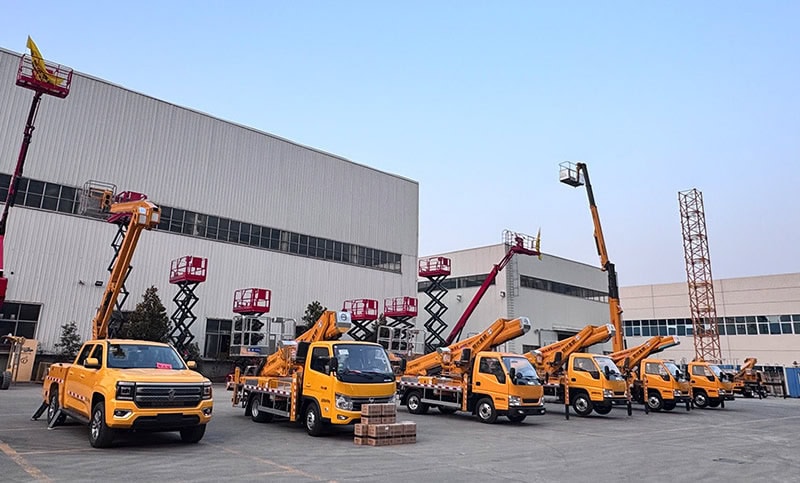
This guide is written for bucket truck operators, utility crew supervisors, site safety managers, and infrastructure maintenance supervisors responsible for aerial lift compliance. It explains OSHA rules for bucket lift operations using the EVERSTAR S32 (HXE5041JGKJ6), a 32-meter lift rated for 200 kg on a JMC chassis, as the reference point.
OSHA Regulations for Bucket Truck and Aerial Lifts Operations
OSHA ranks two obligations above every other requirement in this standard: operator training and personal protective equipment.
Both obligations apply before the boom leaves travel position, on every construction or utility job OSHA covers, and bucket truck operation must follow established OSHA requirements alongside ANSI A92.2–1969 guidelines.
Operator Training and Certification: OSHA 1926.453 Requirements
OSHA 1926.453 requires that a qualified person train every operator before beginning unsupervised aerial lift operations, with no exceptions.
Operators’ training must cover platform controls, the emergency stop at both control positions, pre-operation inspection, ground condition assessment, fall protection, and manual emergency descent: the core safety protocols behind every aerial lift program.
The standard defines aerial lifts broadly: extensible and articulating boom platforms, aerial ladders, vertical towers, and any combination of the above, used to elevate personnel to a working height.
That includes vehicle mounted elevating and rotating work platforms, ladder trucks and tower trucks, under the same 1926.453 obligations as the EVERSTAR S32.
Operators must document training records and keep them on file. An operator who hasn’t logged this training may not run unsupervised aerial lifts, regardless of experience on similar equipment. Documented safety training helps prevent accidents. General truck familiarity doesn’t.
Fall Protection: Personal Fall Arrest System for All Bucket Lift Operators
OSHA 1926.502 requires a fall arrest system anchored to a rated anchor point for every operator, on every ascent.
The required personal protective equipment includes a full-body harness, a shock-absorbing lanyard, and a load-rated anchor. A body belt with a lanyard was once acceptable, but a full-body harness with proper positioning is the baseline now. A body belt alone isn’t enough.
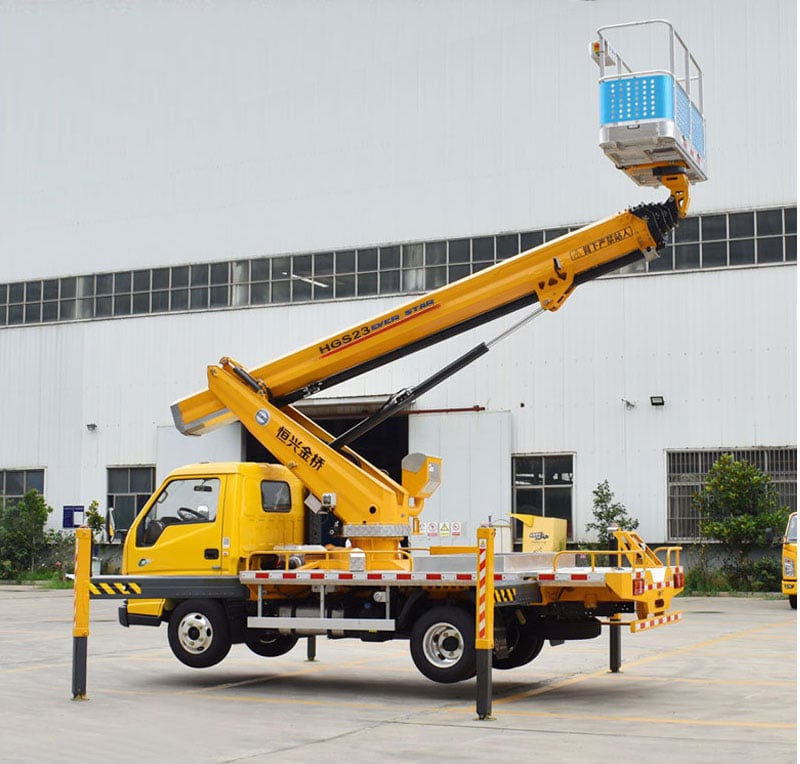
EVERSTAR S32 units include rated anchor points in the basket, part of the broader aerial work platform safety features standard on the model. The same design carries across EVERSTAR’s aerial lifts, so operators can wear fall protection without improvising.
Employees must stand firmly on the bucket floor. OSHA prohibits climbing outside the basket, leaning over the guardrail, or using planks, ladders, or other devices to gain height, at any elevation. These practices protect workers on every truck, construction workers included.
Pre-Operation Checklist: Required Before Every Ascent
Before any deployment, crews check three things: the vehicle and boom, the bucket, and the ground the outriggers sit on.
Skipping any of them turns routine maintenance work into a citation, or worse. These checks prevent accidents. They don’t exist to slow workers down.
Vehicle, Boom, and Platform Condition Checks
Start with fuel and fluid levels, then check the boom’s structural integrity: welds, hydraulic lines, and any boom field modified without certification in writing by the manufacturer.
Check the platform condition: deck, guardrail, gate latch. A gate that doesn’t latch fully is a stop-work issue.
Crews must keep outrigger pads and other equipment present and serviceable. Controls at vehicle and platform level, including the emergency stop, must work before the boom moves, and the manufacturer’s load capacity must be plainly marked on the lift, matching the operator’s manual.
Check tilt alarm and overload warning devices last. Operators should run this pre-operation sequence as part of the broader aerial lift inspection practices they follow regularly. Document the operator’s name, date, and time before the truck leaves the yard.
Ground Condition and Outrigger Setup Before Deployment
OSHA 1926.453 requires a ground condition assessment, a safety step that identifies potential hazards early and keeps personnel clear during setup, before the outriggers go down.
Check surface bearing capacity at each outrigger, confirm no underground utilities beneath the pads, and verify slope tolerance.
Crews check overhead clearance at the same time. A bucket truck on uneven terrain or under a low obstruction creates two hazards at once.
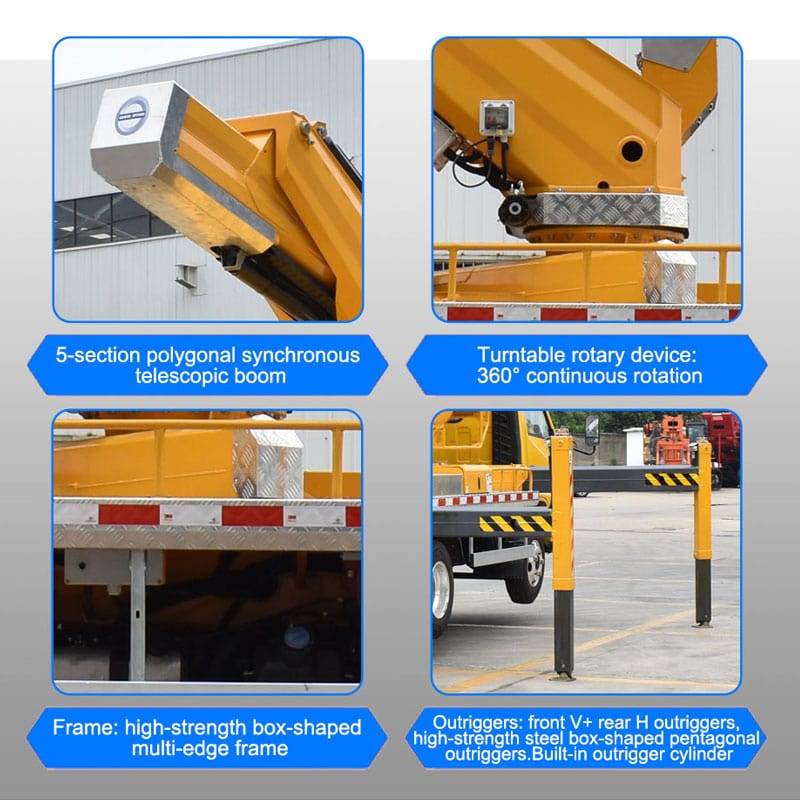
EVERSTAR S32 outrigger span runs 4,600 mm front and 4,200 mm rear laterally, 4,850 mm longitudinally. Soft surfaces under any pad require cribbing, even on level ground.
Safe Operating Practices and Prohibited Actions at Height
Once the platform is elevated, operators must focus on safe operation: load, wind, and proximity to power lines.
The whole crew follows these practices, including workers who aren’t operating the controls.
Load Limits, Wind Speed, and Electrical Hazards When Approaching Power Lines
The EVERSTAR S32 lift is rated for 200 kg, unchanged at any boom position. Operators must read the load chart and never exceed the rated figure before every lift.
Operators shouldn’t work in wind speeds beyond the manufacturer’s limit. Wind loads a boom differently than a static rating accounts for.
Operators must maintain minimum approach distance to power lines at all times, per OSHA 1910.333, and that distance changes with voltage. Brief every operator and ground worker on voltage and exclusion zones before performing work near energized infrastructure.
Electrocution hazards from line contact are a leading cause of injuries on aerial lifts. The distance requirement protects workers from arc flash, which can occur without direct contact.
Prohibited Actions and Emergency Descent Procedure
OSHA prohibits a short list of actions for safety: driving with the boom elevated beyond travel position, positioning the lift over unprotected edges, personnel outside the platform, and using the equipment as a crane attachment, whether the lift is a bucket truck or one of EVERSTAR’s articulating boom platforms. The same rule bars outriggers, ladders, and other devices not rated for the load.
Every operator must know the manual emergency descent procedure before the first lift.
On the EVERSTAR S32, emergency descent activates from the lower controls at vehicle level, so a ground worker can lower the equipment if the operator can’t.
These emergency procedures exist for rare failures. Trained workers who’ve practiced the sequence respond faster than workers seeing it for the first time under pressure.
FAQ — Bucket Lift
What fall protection equipment is required for EVERSTAR S32 bucket lift operations?
OSHA 1926.502 requires a full-body harness with a shock-absorbing lanyard, anchored to the lift’s rated anchor points. A body belt alone isn’t sufficient. Operators must stand firmly on the platform floor and stay inside the guardrail at any height. OSHA prohibits climbing or leaning over the rail.
What ground condition checks are required before deploying a bucket truck at a roadside site?
Confirm surface bearing capacity at each outrigger, check for underground utilities, verify slope tolerance, and confirm overhead clearance. Soft or uneven surfaces require cribbing and other leveling devices under the pads. On the S32, outrigger span (4,600 mm front / 4,200 mm rear lateral, 4,850 mm longitudinal) determines how much level ground the setup needs.
Contact EVERSTAR for S32 Bucket Truck Safety Specifications
We build the equipment and support the safety compliance documentation utility contractors and infrastructure maintenance supervisors need to run their bucket trucks.
Contact EVERSTAR for S32 (HXE5041JGKJ6) outrigger load data, anchor and controls specifications, and guidance on meeting OSHA 1926.453 safety requirements.

