
Discover how to transport solar pile drivers efficiently. Compare dimensions, terrain capabilities, and container options for HXR series models.
Key Takeaways
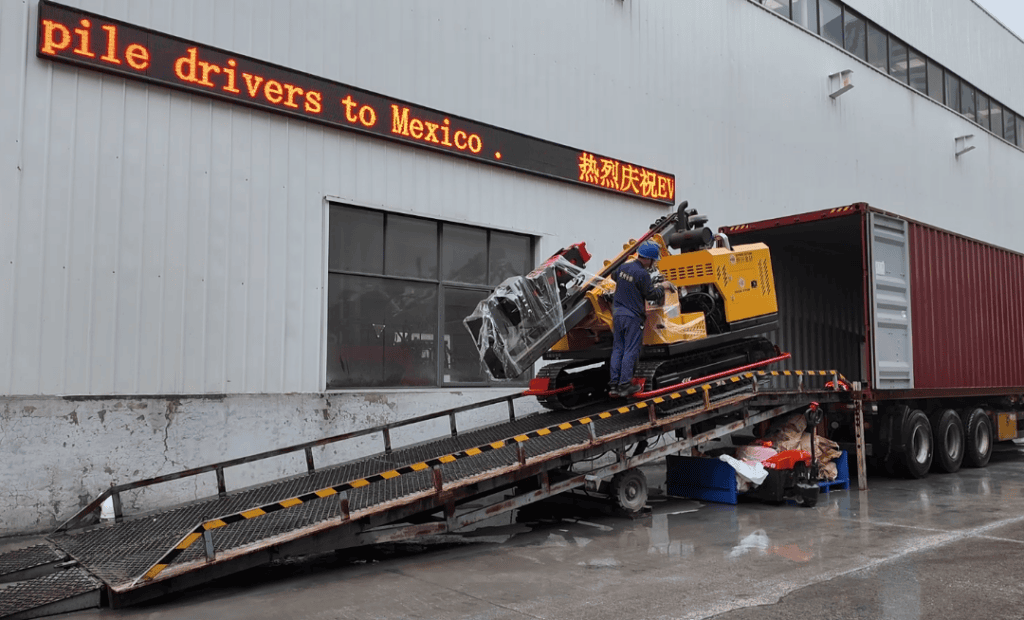
- Modern ground-mounted solar piling equipment features high mobility and a flexible design, making it convenient to transport using standard flatbed trucks or lowboy trailers.
- Choosing the right size of a solar pile driver should take into account geological conditions and required piling depth. Mini pile drivers, medium- and heavy-duty hydraulic hammers, and pneumatic hammers each have their own suitable applications, while all three offer a balance of high efficiency and portability.
- A comparison of the dimensions of four pile driver models can help customers determine the appropriate shipping container size in advance.
Transportation & Mobility of Solar Pile Driving Equipments
When planning ground-mounted solar installations, a common concern for contractor teams is project logistics. Just how easy is it to transport a solar pile driver to your construction site? Modern solar pile driving equipments are engineered with high mobility in mind. Unlike rigid, heavy weight traditional rigs used for large structures like bridges and high-rise buildings, solar pile driving machinery is built to be easily loaded onto standard low-boy trailers or flatbed trucks. Whether moving between distant projects or maneuvering across rough terrain, flexible pile driving machine designs allow your team to maintain efficiency and strict schedules without complex transit logistics.
Machine Sizes & Power Systems: Choosing the Right Setup
Selecting the correct rig size depends on the required driving force, depth, and local ground conditions. Solar pile foundations require absolute precision and long-term structural integrity to support solar racks for decades.
Compact & Mini Pile Drivers:
Ideal for shallow ground penetration and soft soil, these agile machines minimize ground compaction while keeping transport dimensions lightweight and compact.
Mid-to-Heavy-Duty Hydraulic Hammers:
For hard-packed earth or rocky ground, a robust hydraulic impact hammer (or advanced hydraulic hammers) delivers high impact energy using precise hydraulics. The hydraulic system provides intense driving force without adding excessive transit bulk.
Pneumatic & Specialized Air Hammers:
Utilizing compressed air from an external compressor, air hammers offer high frequency with low vibration, allowing clean driving of steel or concrete piles without risking damage to adjacent components. While older heavy industry relied on diesel and air hammers or even legacy steam systems that required an explosive fuel ignition form, modern solar installation rigs prioritize efficient fuel consumption, ease of trailering, and rapid setup.
Comparison of Different Types of Pile Driving Machines

HXR3: Compact Agility for Confined Sites & Small Projects
- Dimensions: Working Height: 4500 mm | Working Width: 2280 mm
- Terrain & Site Suitability: The HXR3 is the most compact model in the series, designed specifically for small-to-medium residential solar installations, rooftop-adjacent ground mounts, or agricultural projects. Its lower working height (4.5 m) makes it ideal for sites with overhead restrictions, low-hanging cables, or tight, confined spaces where maneuvering larger machinery is impossible.
- Container & Transport Choice: Thanks to its minimal footprint, the HXR3 can easily fit into a standard 20ft General Purpose (GP) Container. If you are shipping multiple units or mixing cargo, two HXR3 units can be efficiently loaded into a 40ft High Cube (HC) Container, significantly lowering your ocean freight cost per unit.
HXR5: The Balanced All-Rounder for Moderate Terrains
Dimensions:
Working Dimensions: Length 3500 mm × Width 2100 mm × Height 7500 mm
Transport Configuration (Folded): 6500 mm (L) × 2250 mm (W) × 2450 mm (H)
Terrain & Site Suitability: Featuring a standard track unit, the HXR5 offers excellent stability and adaptability for rolling hills, moderate slopes, and uneven farm fields. It handles taller solar posts (up to 7.5 m working height) while maintaining a balanced footprint, making it a go-to choice for commercial ground-mounted solar farms.
Container & Transport Choice: When folded for transport, its height drops to 2450 mm. A standard container door height is around 2.28m–2.58m depending on the type, so the HXR5 is perfectly suited for a 40ft High Cube (40HQ/HC) Container (door opening height ~2.58 m / internal height ~2.70 m) or an Open Top (OT) Container if overhead crane loading is preferred.
HXR6: Heavy-Duty Stability for Rugged & Challenging Ground
Dimensions:
Working Length: 3085 mm | Working Width: 2735 mm | Working Height: 6000 mm | Weight: 6200 kg
Terrain & Site Suitability: Built with a wider track width (2735 mm) and a heavier operational weight (6,200 kg), the HXR6 excels in demanding off-road conditions—such as muddy ground, rocky terrain, steep slopes, and soft soils. The wider base prevents sinkage and provides supreme stability when driving long piles on challenging topography.
Container & Transport Choice: Due to its wider track base (2735 mm), loading through standard container doors (which typically have a width of ~2.34 m) requires careful planning. For international shipping, the HXR6 is best transported using a 40ft Flat Rack (FR) Container or via Ro-Ro (Roll-on/Roll-off) / Breakbulk shipping. For domestic road transport, a standard lowboy trailer/flatbed truck handles its 6.2-ton weight with ease.
HXR7: Max-Reach Powerhouse for Large-Scale Utility Solar
Dimensions:
Working/Transport Length: 6300 mm | Working Width: 2100 mm
Transport Height: 6900 mm (Masted/Unfolded)
Terrain & Site Suitability: The HXR7 is engineered for large-scale utility solar power plants where high-efficiency piling and longer mast clearance are required. Its 6.3m length provides maximum stability during heavy-duty pile driving, making it capable of handling large-diameter posts across flat deserts, expansive plains, and utility-scale fields.
Container & Transport Choice: With a mast transport height reaching 6.9 meters when fully raised, the mast structure must be lowered/folded down or disassembled prior to loading. Once collapsed to standard transport dimensions, it can be loaded into a 40ft High Cube (HC) Container or an Open Top (OT) Container. For fully assembled multi-unit logistics, Flat Rack (FR) or Ro-Ro vessels offer the fastest mobilization without full disassembly.
Transporting Equipment Safely to Ensure Installation Stability
Transporting your pile driver safely is critical to preserving its calibration and ensuring seamless field installation. Proper transport procedures hold key machinery components in place, preventing structural strain from transit vibrations. Once offloaded at the construction site, a well-maintained pile driving unit can immediately begin driving piles into the earth to create an ultra-stable foundation. By matching the machine’s weight, energy output, and transport profile to your job site demands, you guarantee structural stability for the entire solar field.
FAQs
What size shipping container do I need to transport a solar pile driver internationally?
Container selection depends on your machine’s dimensions and foldability:
- 20ft Standard Containers are ideal for compact models like the HXR3 or smaller machinery.
- 40ft High Cube (40HQ) Containers best suit foldable mid-to-large models (such as the HXR5 and HXR7), provided the height and track width fit within standard door clearance (~2.34m W × 2.58m H).
- 40ft Flat Rack (FR) or Open Top (OT) Containers are recommended for heavy-duty, wide-track models like the HXR6 (track width over 2.7m) or tall masted rigs that cannot be fully collapsed into standard box containers.
How do I choose the right solar pile driver model based on site terrain?
Consider the slope, soil conditions, and spatial constraints of your project site:
- Tight or Confined Spaces: Choose compact models with lower working heights (e.g., HXR3) to safely maneuver around existing structures, power lines, or farm trees.
- Rolling Hills & Moderate Slopes: Select mid-range all-rounders (e.g., HXR5) that strike a balance between mobility and post clearance.
- Muddy, Rocky, or Steep Ground: Opt for wide-track, heavy-weight models (e.g., HXR6) to maximize ground traction and prevent tilting during piling.
- Flat, High-Volume Utility Sites: Use long-reach, high-mast rigs (e.g., HXR7) built for fast, repetitive installations over expansive flatlands.
Contact EVERSTAR for Different Types Of Solar Pile Drivers
Just contact EVERSTAR for high quality machines for your construction project. EVERSTAR pile drivers are designed to adapt to a wide range of working environments, delivering efficient piling performance to help ensure that construction projects are completed on schedule.

