
Key Takeaways
- A scissor lift with a compact footprint that fits standard doors in a straight line can still need far more lateral space to make the turn.
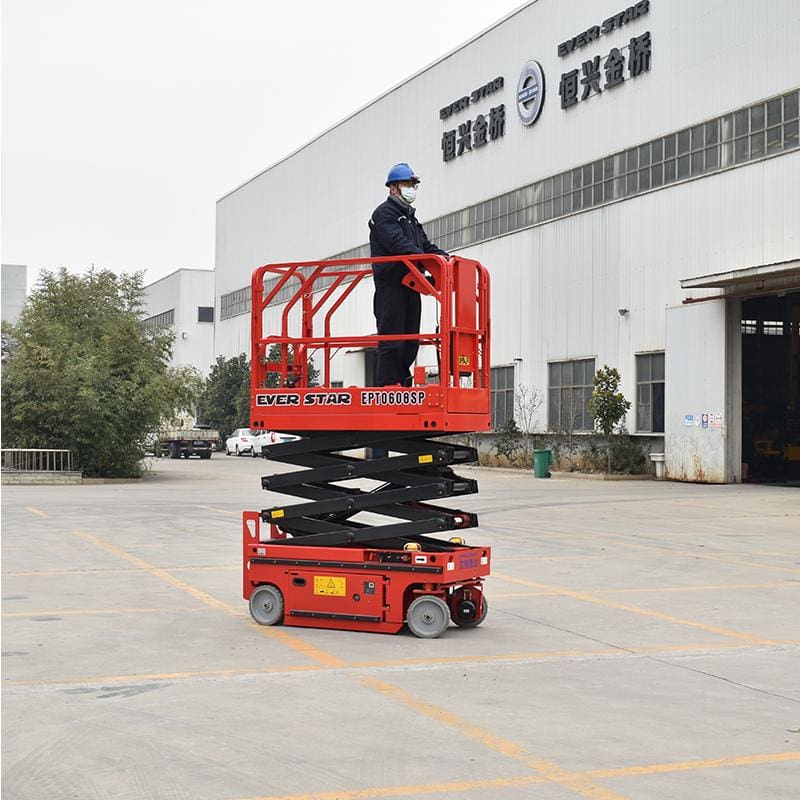
- EVERSTAR’s electric scissor lift range (Wheeled Series) spans working heights from 6-12m with platform capacity from 200-350 kg, sized for indoor deployment in confined areas.
- Battery range and routine maintenance checks must both cover every planned zone before the shift begins.
A facility maintenance planner or contractor booking a narrow-space scissor lift will face the challenge of working in buildings not designed for aerial equipment. Retail stores, warehouse mezzanines, and commercial buildings with standard doors are typically laid out for foot traffic and storage racks, not for maneuvering lifts.
Machine Width and Turning Clearance
Machine width decides whether a scissor lift passes through a doorway or aisle in a straight line, while turning clearance decides whether it can change direction once inside. Narrow electric scissor lifts are commonly about 30 to 32 inches wide, which makes a narrow lift easier to match to the available workspace.
A unit that clears a standard door straight-on may still need well over a meter of extra lateral space to complete a 90-degree turn into that same doorway. Turning radius, not just platform width, decides whether that turn is possible at all.
Machine Width vs. Turning Clearance: Why Both Must Be Checked on the Access Route?
Confined spaces with racking on both sides remove that lateral margin entirely, which is why a route survey has to check both figures at every junction on a narrow scissor lift’s planned route, not just the narrowest opening.
Skipping the turning-clearance check is one of the most common planning errors on indoor jobs. A machine specified purely against door width can still get stuck at the first corner, forcing a mid-shift swap and losing the maintenance window.
Comparing the scissor lift sizes by height, width, and load is crucial to understand which machine can be checked before booking.
How Chassis Width Affects Stability at Working Height in Narrow Spaces?
A narrower chassis and compact design reduce the machine’s base footprint, keeping the platform stable once it reaches working height. EVERSTAR’s electric scissor lift range, Wheeled Series, covers working heights from 6-12m with 200-350 kg platform load, sized for the narrow aisle work this article addresses.
These electric models run at zero emissions with quiet operation, an advantage in smaller spaces where compact size reduces disruption to shoppers or staff nearby.
Compact models suit single-operator routes at maximum height, while multiple workers rotating through the same facility benefit equally from a machine that starts and stops without the noise or exhaust a fuel-powered unit produces.
Deployment Route Planning Across Multi-Zone Indoor Facilities

Mapping the Access Route: From Entry to Work Position Across All Zones
An indoor maintenance route spanning several zones should be walked and mapped from the entry point to every planned work position before the scissor lift arrives on site.
Three points decide whether the plan holds: the narrowest passage, the sharpest turn, and any threshold or ramp that changes floor level. Those three constraints set the maximum width a scissor lift’s route can support.
Retail spaces and commercial buildings frequently mix zones of different widths, and a model that clears the loading dock and main aisle can still be ruled out by one tight corner near a stockroom. Scissor lift weight capacity and dimensions help confirm platform width and load together before the route is finalized.
Battery Range Planning for Multi-Zone Deployment Without Recharge Interruptions
Electric scissor lifts covering multiple zones in one shift need a battery plan for travel distance and platform cycles at working height. Add up the distance between zones and the raise-lower cycles expected at each stop, then compare that total against the machine’s stated operating range.
A route that looks short on paper can still draw down the battery faster once cycle counts at different working heights are factored in, especially on an indoor maintenance shift with no time for a recharge stop.
Confirming electric scissor lift specifications helps avoid a stranded machine mid-route in a facility where the unit cannot be retrieved for recharging without disrupting other zones.
Comparing Narrow Aisle Scissor Lift Widths Across Application Profiles
Chassis width is only one dimension to confirm. Platform height and lift height are often confused: platform height is the deck’s height off the ground, while lift height on boom-style equipment includes reach beyond the platform edge.
Platform width and turning radius decide whether the unit clears a corner, and platform capacity with load capacity decide what the operator can carry at working heights.
Application Profile: Single-Aisle Repetitive Tasks vs. Full-Facility Route Coverage
Not every indoor job needs a narrow scissor lift. Single-aisle repetitive work, such as light replacement or racking inspection confined to one row, allows the widest machine that still fits that one aisle, which maximizes platform size and stability for the task.
Full-facility route coverage is a different problem: it requires the widest machine that clears every constraint across the whole route, typically set by the tightest single point rather than the average.
This prevents two common mistakes: over-specifying a wide, stable platform that gets stuck at one corner, or under-specifying a narrow scissor lift when the job never leaves a single aisle wide enough for a larger platform. EVERSTAR’s scissor lift lineup spans Wheeled Series models built for this kind of indoor work.
EVERSTAR’s full range covers indoor and outdoor construction applications. Compact electric models suit indoor tasks in tight spaces and open spaces alike, while wide scissor lifts and rough terrain lifts handle outdoor projects across rough terrain and uneven surfaces, where heavier loads or two workers on the platform are often needed.
Wide scissor lifts offer greater platform capacity and stability than a narrow-chassis model, and larger scissor lifts or boom lifts cover reach beyond a compact unit’s capacity. Wider models and standard models both have a place in a facility’s equipment plan once the application profile is confirmed.
FAQs — Compact Scissor Lift
What is the difference between chassis width and turning clearance for a compact scissor lift?
Chassis width is the machine’s fixed dimension: it determines whether an electric scissor lift built for indoor use passes through a doorway or aisle in a straight line. Turning clearance is the extra lateral space needed to change direction at a corner or doorway approach, often much larger than the doorway itself. Both must be checked at every junction on the access route.
How do I plan battery range for a compact scissor lift covering multiple indoor zones in one shift?
Add total travel distance to the expected platform cycles at working height across every zone on the route, then compare that figure to the machine’s stated operating range. Battery draw rises with cycle frequency, not just distance, so plan charge points before reserve runs low during an indoor maintenance shift.
Contact EVERSTAR for Compact Scissor Lift Selection
Contact EVERSTAR’s sales team directly to review machine width, turning clearance, battery range, and required platform capacity by model, confirm purchase price, and get a recommendation sized to your facility’s tightest access point.

