
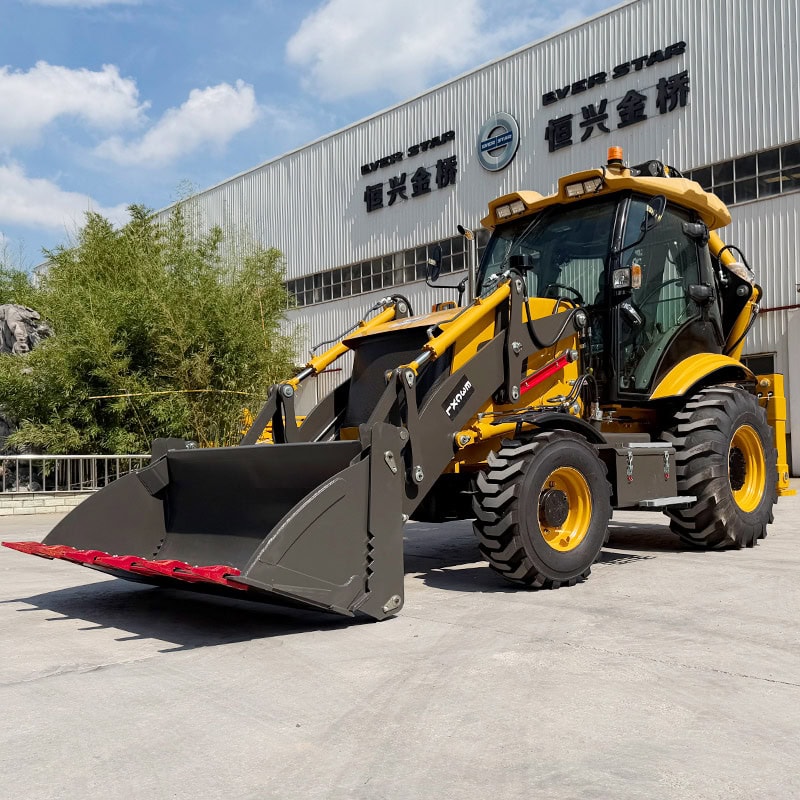
Key Takeaways
- Telescopic digging depth reaches 5200 mm on the E3CXL and 5300 mm on the E4CX, covering most utility trenching and footing work.
- The E4CX delivers 46 kN of digging force versus 36 kN on the E3CXL, a 28% gain that shows up in compacted, rocky, or clay soils.
- Backhoe loader lift capacity favors the E4CX, which reaches a 6300 mm lift height and a 2800 mm unloading height for loading trucks.
- Front bucket volume runs from 1 m³ (E3CXL) to 1.2 m³ (E4CX); breakout force is identical at 72 kN on both models.
A backhoe that can’t reach the bottom of a trench, or can’t lift a full bucket over a dump truck’s side rail, turns a one-machine job into a two-machine problem.
Backhoe loader capacity means the machine’s rear excavation and front loading limits: digging depth and digging force at the back, plus lift height, unloading height, and bucket volume at the front.
In practice, the key factor is what tells you whether a model can handle the trench depth, soil resistance, and truck-loading work on your site without adding another machine or slowing the job.
This comparison walks through the multiple sizes and the E3CXL/E4CX model differences, so contractors, procurement teams, project engineers, and construction managers can choose the right backhoe loader for the work.
Rear Excavation Capacity in Backhoe Loaders: Digging Depth, Radius, and Force Compared by Model
Rear excavation capacity decides whether a backhoe loader can deliver strong handling for trench work, utility installation, and foundation work on a given site: it comes down to depth, radius, and digging force.
Digging Depth: Standard Reach and Telescopic Extension
The E3CXL reaches a telescopic digging depth of 4000/5200 mm (standard/extended); the E4CX reaches 4000/5300 mm.
The telescopic arm adds roughly 1200–1300 mm of reach beyond the standard position, which is the number that matters for utility trenching, drainage runs, and footing work below 4000 mm.
The E4CX’s extra 100 mm gives a small margin on the deepest cuts.
Digging Force and Radius: Performance in Hard Soil and Compact Material
The E3CXL produces 36 kN of digging force with an 840 mm radius; the E4CX produces 46 kN with a 900 mm radius.
That 28% higher digging force on the E4CX pays off in compacted, rocky, or clay soils, where a lower-force loader has to work the arm back and forth instead of cutting through in one pass.
The wider radius also means more dirt collected per cycle, fewer passes to clear a trench section, which adds up across a full day of digging trenching and utility work on any excavator-class machine.
Front Loader Lifting Capacity: Lift, Bucket Volume, and Dump Reach
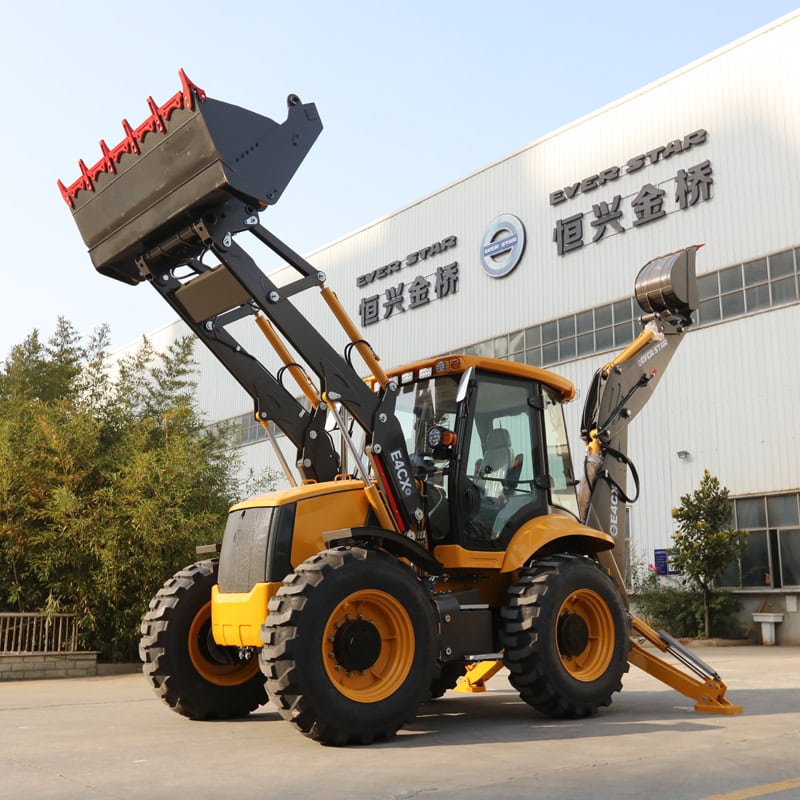
Front loading capacity is the other half of the equation: loader lift capacity, lift height, unloading distance, and bucket volume, rather than pure digging.
As a benchmark, a backhoe loader is for large-scale excavation, with lift capacities commonly ranging from 6,500 lbs to 13,000 lbs, and general-purpose front loader buckets usually range from about 0.76 to 1.5 cubic yards.
Lift Height and Unloading Distance: Loading Into Trucks and Over Barriers
The E3CXL reaches a maximum lift height of 5200/5950 mm, a 2650 mm unloading height, and a 1062 mm unloading distance.
The E4CX reaches 5800/6300 mm, with a 2800 mm unloading height and an 800 mm unloading distance.
The E4CX’s higher unloading height suits loading into dump trucks without the bucket catching the side rail; the E3CXL’s greater unloading distance gives more forward reach when the loader can’t pull alongside the pile.
Front Bucket Capacity: Volume and Breakout Force
The E3CXL carries a 1 m³ front bucket at 72 kN of breakout force. The E4CX steps up to 1.2 m³, also at 72 kN.
Since loader breakout force is equal on both, the extra loader bucket volume only changes cycle throughput. The model choice here is about volume.
Moving asphalt, aggregate, or demolition debris in high volume clears a stockpile faster with the E4CX. For tight spaces, the E3CXL’s smaller footprint may be preferred.
Machine Weight and Stability: How Operating Weight Affects Capacity Performance
Machine operating weight directly impacts stability during digging and lifting at the limits of a backhoe loader’s capacity. That same weight also sets the ground bearing demands a job site has to meet before either model can work at full capacity.
Operating Weight and Its Role in Digging and Lifting Stability
Every number above assumes the backhoe loader holds still long enough to reach it. Weight makes that possible: the E3CXL weighs 7300/8000 kg depending on configuration; the E4CX weighs 9500 kg.
That extra mass on the E4CX gives more counterbalance when digging at full depth and also when ground clearance or the lift is at maximum height, the two moments a lighter loader is most likely to lose better stability.
Heavier machines hold their rating more reliably at the extremes, but the machine’s weight also raises the ground bearing demand beneath it.
Ground Conditions and Machine Weight: Site Preparation for Full-Capacity Operation
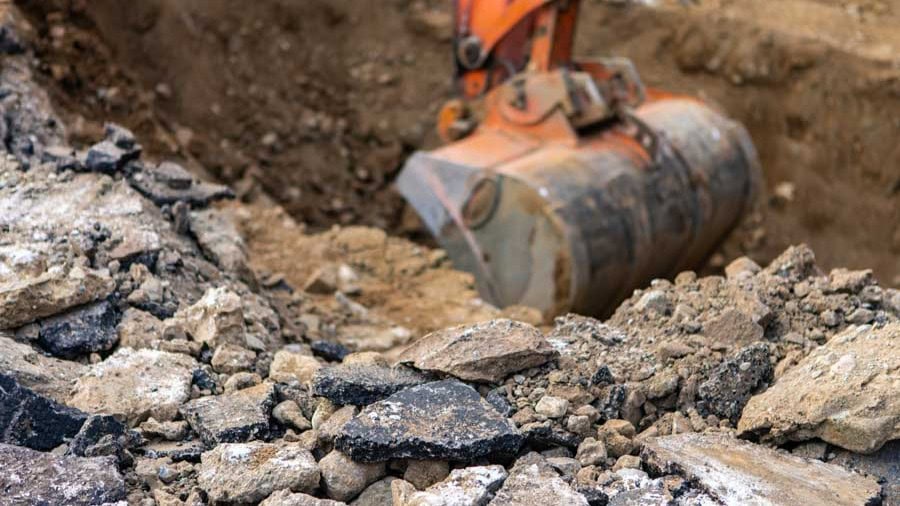
Both models need stable, load-bearing ground at the outrigger and tyre contact points before working at full capacity. The E4CX’s higher weight, at 9500 kg, calls for confirming ground bearing capacity on soft or recently disturbed sites.
Outrigger deployment and level ground positioning are required before rear excavation at maximum depth and digging force. Skipping this step is where a rated spec and a job site’s actual performance start to diverge.
FAQs — Backhoe Loader Specs and Capacity (E3CXL & E4CX)
What is the digging depth difference between the EVERSTAR E3CXL and E4CX with telescopic arm?
The E3CXL reaches a telescopic digging depth of 5200 mm; the E4CX reaches 5300 mm, a 100 mm difference. Both extend about 1200–1300 mm past their 4000 mm standard position. For most trenching and footing work, either model covers typical depth requirements—the E4CX’s extra reach only matters on the deepest cuts near each machine’s rated limit.
Which model offers greater front bucket capacity for truck loading operations?
The E4CX offers greater bucket volume at 1.2 m³, versus 1 m³ on the E3CXL. Breakout force is identical at 72 kN on both, so the E4CX simply moves more material per cycle rather than digging harder. For high-volume truck loading the E4CX cuts cycle count; for smaller loads or tighter job sites the E3CXL is often enough.
Choose the Model on Digging Depth, Bucket Volume, and Ground Stability
EVERSTAR’s backhoe loader lineup covers telescopic digging depth up to 5300 mm and up to 1.2 m³ in bucket volume, making these versatile machines for general construction equipment needs.
The E4CX delivers higher digging force for heavy loads and greater lift capacity for demanding digging, truck loading, and other earthmoving work in rough terrain; the E3CXL offers lighter weight and greater unloading distance where ground conditions, landscaping access, or reach matter more than raw power.
Compare specs against the job first (required depth, soil type, load frequency, ground bearing capacity, and whether hydraulics support the attachments you plan to run) before you compare specs against each other.
Many contractors evaluating wheel loaders or a mini excavator alongside a backhoe loader find one well-matched machine can replace two machines, with fuel efficiency and enough output to handle the work without a second rig on site; by contrast, compact backhoes are often under 6,000 pounds with 20 to 50 horsepower, which helps explain when a larger backhoe loader is the better one-machine choice.
Contact EVERSTAR for Backhoe Loader Specs and Model Guidance
Project engineers, construction managers, and procurement leads comparing digging depth, lift capacity, and bucket volume across EVERSTAR’s E3CXL and E4CX specifications can contact EVERSTAR directly for full specs and models typically measured to match your project’s depth and loading needs.

