
Discover key factors in pile driving equipment selection for solar farms. Learn how budget, machine size, project scale, and soil conditions impact your pile driver choice.
Key Takeaways
- When selecting pile-driving equipment for solar power plants, it is essential to balance initial purchase costs against long-term operating and maintenance expenses. Investing in efficient and reliable equipment helps reduce costs, improve productivity, and maximize project profitability.
- Selecting the right-sized solar pile driver requires balancing terrain maneuverability with transportation convenience. Choosing the appropriate model ensures an optimal balance between power and flexibility, ultimately improving construction efficiency.
- Before pile-driving operations begin, the soil conditions and required load capacity must be assessed. The appropriate pile-driving equipment and techniques should then be selected based on the specific geological conditions to ensure foundation stability and improve construction efficiency.
Why Is Preparation Important When Making a Choice?
Mitigate the Significant Risk of Equipment-Site Mismatch: Purchasing equipment without conducting a preliminary site assessment can lead to serious problems. If the machine encounters hard bedrock, isolated boulders, or highly cohesive clay during construction, it may be unable to drive piles to the required depth or may suffer drill bit damage.
Accurately Calculate the Total Cost of Ownership (TCO) to Prevent Cash Flow Problems: New equipment typically experiences higher depreciation rates during its first few years. Used equipment, while requiring a lower initial investment, can incur substantial repair costs and downtime losses if its hydraulic system and engine are not thoroughly inspected. These additional expenses may ultimately exceed the price difference between used and new equipment.
Ensure Project Schedule Compliance and Contractual Performance: In large-scale utility-scale solar power plants and infrastructure projects, pile driving is the first stage of the entire construction process. Frequent equipment breakdowns and downtime can bring subsequent operations, such as mounting structure installation and solar panel deployment, to a standstill, resulting in costly delay penalties.
Address Construction Environment and Regulatory Requirements: When working near residential areas or utility-dense zones, strict noise and ground vibration limits may apply. These restrictions directly influence the choice between impact-driven pile installation and lower-disturbance auger piling methods.
Budget and Cost Efficiency
Budget considerations play a decisive role in pile driving equipment selection for solar farm construction. Initial capital expenditure must be balanced against long-term operational costs, fuel efficiency, and maintenance requirements. Choosing a high-efficiency pile driver with reliable hydraulic components can significantly reduce downtime and lower labor expenses. Investing in versatile machinery tailored to your financial scope ensures cost-effective pile installation without compromising structural safety or project profitability.
| Used Pile Driver | Brand-New Pile Driver | |
|---|---|---|
| Capital Expenditure (CapEx) | Lower (typically 30%–60% of the price of a new machine) | Higher (requires full payment or a 20%–30% down payment) |
| Operating Costs (OpEx) | Higher (higher failure rates, fuel consumption, and maintenance costs) | Lower (typically requires only routine maintenance during the initial warranty period) |
| Downtime Risk | Risk of downtime due to aging hydraulic systems and engines | Very low, helping ensure project milestones are met |
| Residual Value and Resale | Limited depreciation potential, with much of the value already depreciated | Fastest depreciation during the first two years |
| Financing and Tax Benefits | Higher barriers to financing and invoicing | Access to low-interest financing and full input VAT deduction |
Machine Size and Mobility
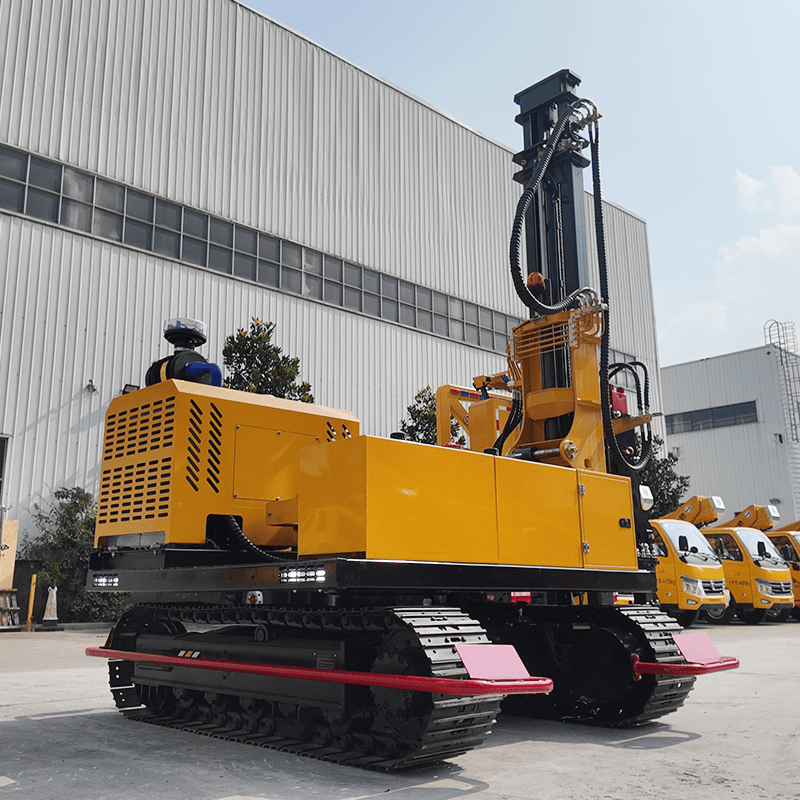
Selecting the appropriate machine size depends heavily on ground maneuverability and transportation limits across the solar site. Compact or medium-sized crawler pile drivers are often ideal for navigating narrow rows between photovoltaic panel arrays and working on soft ground. A well-sized rig offers the optimal balance of power, transportability, and flexibility, allowing workers to move smoothly between driving locations while maintaining precise positioning and rapid setup times.
| HXR3 (Mini Model) | HXR5 (Standard High-Efficiency Model) | HXR6 (Heavy-Duty Balanced Model) | HXR7 (Mountain / All-Terrain Model) | |
|---|---|---|---|---|
| Machine Weight | 2,900 kg | 5,500 kg | 6,200 kg | 7,500 kg |
| Engine Power | 53 kW | 97 kW | 97 kW / 53.7 kW | 97 kW |
| Ideal Ground Conditions | Typical soft soil, loess, and agricultural topsoil | Typical medium-dense clay, sandy soil, and loess | Medium-hard clay containing some gravel or highly weathered rock | Mountainous terrain, hard soil, strongly weathered rock, slightly weathered rock, cobbles, and complex geological formations |
| Ideal Construction Environments | Confined spaces, sites with low ground-bearing capacity, and small-scale projects | Open plains with level terrain, tight project schedules, and large-scale water or agricultural projects in plains and wastelands | Sites with moderate space constraints and specific requirements for impact energy and ground adaptability (180° rotation) | Uneven slopes, mountainous areas, and photovoltaic power plant projects requiring large-scale operations and versatile equipment |
| Core Features and Configurations | Basic pile driving, small-diameter auger drilling, and optional DTH drilling | High-efficiency pile driving, standard deep-hole drilling, and drilling speeds of up to 3,200 mm/min | Enhanced pile-driving energy (up to 1,960 J), stable hydraulic performance, and 180° rotation | Fully equipped configuration, large-diameter auger drilling (up to 800 mm), DTH drilling (up to 500 mm), and a 30° super-gradeability capability |
| Key Advantages | Extremely lightweight: Flexible relocation, minimal ground disturbance, and low purchase and transportation costs | High cost-effectiveness: Delivers the highest number of piles per unit of time under typical operating conditions | Powerful performance: Combines stable pile driving with strong drilling capability, making it suitable for medium-hard soil conditions | All-terrain capability: Excellent performance on hard rock and steep mountain slopes, with one machine capable of replacing multiple types of equipment and reducing equipment changeover costs |
Environmental and Ground Conditions
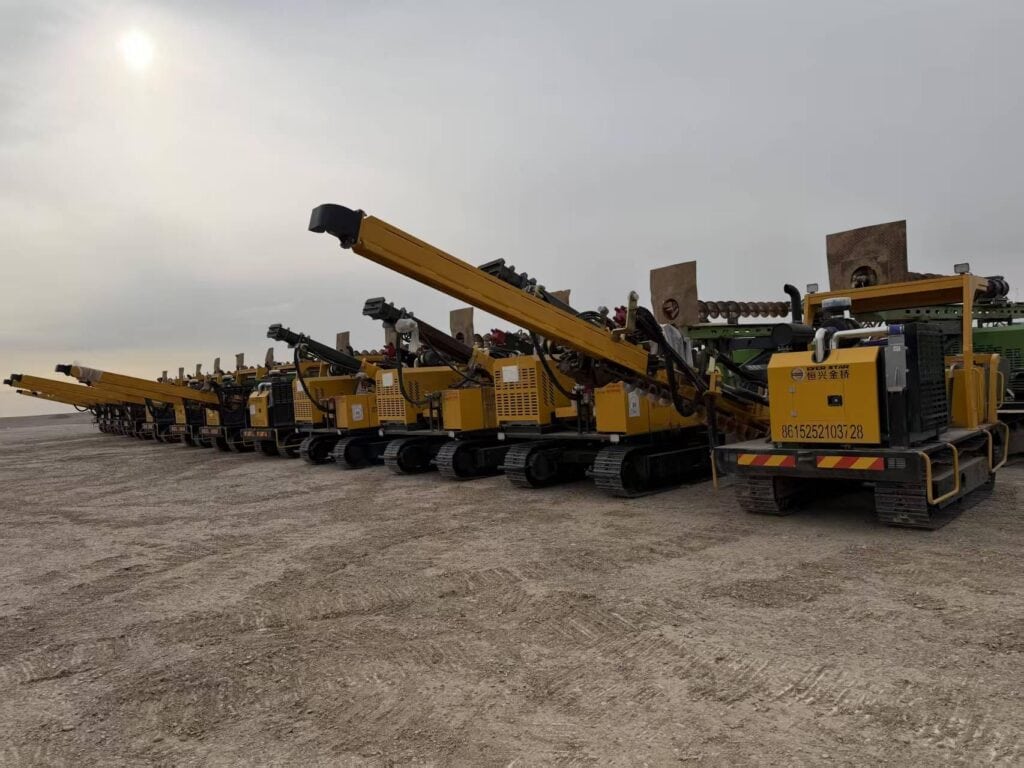
To successfully achieve optimal performance, engineers must analyze soil conditions and other factors like soil density, required load, and the expected blow count. Whether you are examining a specific case study or planning large-scale projects, evaluating equipment capabilities—including power, weight, and components of each system or device—makes a strong impact on the overall installation efficiency. Rocky or hard soils may require specialized hydraulic hammers or pre-drilling attachments, whereas soft or sensitive terrains benefit from vibratory driving systems that minimize ground disturbance. Matching equipment capabilities to specific geological conditions guarantees high foundation stability and prevents machine wear during operation.
| Auger Pile Driving | Direct Hydraulic Impact Pile Driving | Percussion Drilling / DTH Hammer | |
|---|---|---|---|
| Core Principle | Rotary cutting and penetration | High-frequency hammering and downward impact | Impact crushing and rock drilling |
| Ideal Ground Conditions | Dense clay, sandy soil, and highly weathered soft rock | Typical soil, loess, and medium-dense sand | Hard bedrock, slightly weathered rock, and cobble or gravel layers |
| Typical Construction Environments | Urban outskirts, vibration-sensitive areas, and sites with strict environmental requirements | Open plains, wastelands, and sites requiring high efficiency under tight schedules | Mountainous areas, slopes, and exposed rock zones |
| Construction Efficiency | Moderate (requires drilling or screwing into the ground, resulting in longer operation times) | Very high (direct impact driving delivers the fastest single-pile installation) | Lower (slower drilling in hard rock and more operational steps) |
Advanced options like vibratory hammers and a heavy-duty hydraulic hammer are often developed to meet diverse requirements. This design is influenced by ground properties, where a low number of strikes or stable driving means reliable support.
FAQs
Which is better for solar farm construction: a hydraulic hammer or a vibratory hammer?
The choice depends on ground properties. A hydraulic hammer provides high impact power, making it ideal for dense, hard, or rocky ground where high refusal limits must be overcome. Conversely, vibratory hammers are better suited for cohesive, granular, or soft soils, offering fast driving speeds with reduced ground disruption and lower noise levels.
What factors should be considered when selecting pile driving equipment for a solar farm?
Key factors include soil conditions (such as rock, clay, or sand density), required foundation depth, daily production targets based on project scale, machine size and site accessibility, and total budget. Matching the right pile driver and hammer mechanism to these variables ensures high stability and efficient installation.
Contact EVERSTAR for Hydraulic Pile Driving Equipment
Ensuring site access and safety for workers is equally vital, and a professional team can hold responsibility from the start to final service. For more example details or to contact experts, look for the sign or image on our website and start making informed decisions for your next foundation deployment.

