
Key Takeaways
- A Kelly bar drill rig depends on stable torque transfer between the rotary drive and the drilling tool to maintain borehole accuracy and drilling consistency.
- Interlocking Kelly bars use a mechanical locking system to maintain section engagement under high load and deeper drilling conditions.
- Friction Kelly bars rely on gravity-assisted crowd force and are better suited to moderate ground conditions and controlled drilling depth.
- EVERSTAR’s reinforced key structure, double collar design, and high-strength materials improve drilling stability in hydraulic rotary drilling rigs and piling rigs.
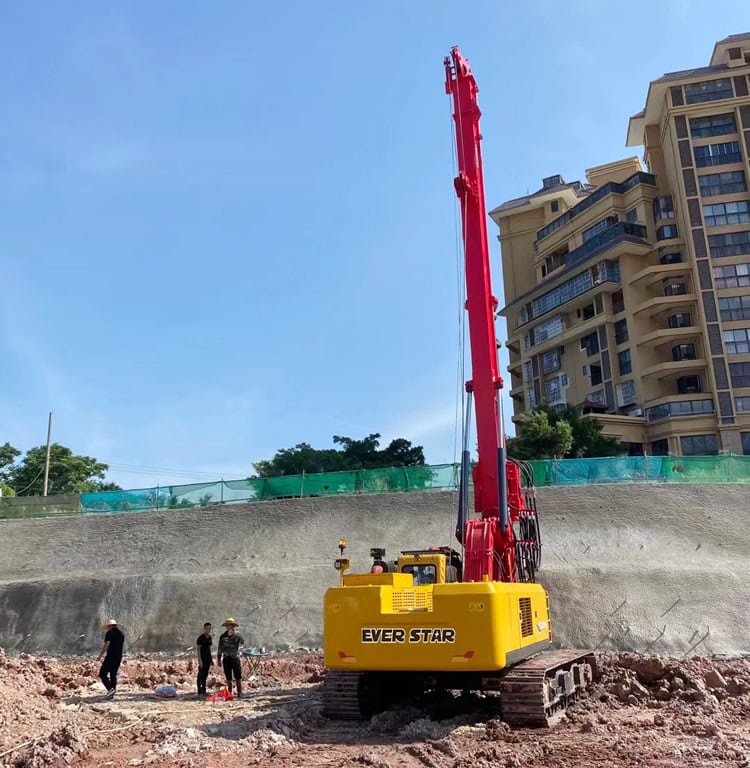
In rotary foundation drilling, the Kelly bar is the telescopic drive rod responsible for transferring rotary drive energy from the drilling rig to the drilling tool during deep foundation construction.
Because this transfer happens through multiple telescopic sections under continuous load, the design of a kelly bar drill rig directly affects drilling stability, penetration consistency, and achievable depth.
Bar type, section count, welded structure, material specification, and site safety practices aligned with OSHA guidance are, therefore, engineering decisions rather than interchangeable preferences.
EVERSTAR designs interlockingKelly bars and friction Kelly bars specifically for hydraulic rotary drilling rigs used in deep foundation work.
Their systems incorporate reinforced drive ribs, double collar structures, and high-strength materials such as 35CrMo, 30CrMo, ZT600, and Q550 steel to improve torque stability and operational reliability.
How Torque Travels from Rotary Rig to Drilling Tool
Inside a Kelly bar drill rig, torque follows a defined mechanical path. Rotary drive force travels from the rotary drive head into the Kelly bar adapter, then through the telescopic Kelly sections before reaching the drilling tool at the base.
Both interlocking Kelly bars and friction Kelly bars transmit torque through drive ribs, drive stub engagement, and lock devices. The main difference is not how torque is transferred, but how vertical load is controlled during drilling.
In hydraulic rotary drilling rigs, uninterrupted transfer is critical because instability increases as drilling depth grows.
The drilling rig depends on several key components working together:
- rotary drive tool engagement.
- welded drive ribs.
- mechanical locking system stability.
- telescopic section alignment.
- consistent load distribution.
When these elements remain stable, piling rigs maintain cleaner drilling geometry and more predictable penetration rates.
Why Stable Torque Transfer Produces Better Drilling Results
Consistent torque transfer improves drilling precision by allowing the drilling tool to maintain a more uniform cutting path, reducing deviation and improving borehole geometry.
In deep foundation construction, this affects:
- drilling depth consistency.
- crowd force control.
- borehole stability.
- drilling speed.
- tool reliability.
EVERSTAR’s interlocking Kelly bars use reinforced welded key structures and double collar reinforcement to stabilize load transfer during operation. The drive ribs cross the flange area to distribute stress more evenly along the outer scope of the Kelly sections.
If transfer stability drops, drilling tools can oscillate under load, reducing drilling efficiency and increasing maintenance requirements. A damping noise system helps mitigate these vibrations, protecting structural components and improving operator safety during high-load drilling cycles.
What Happens When Torque Capacity Is Compromised
Torque capacity decreases when the section count increases excessively or when the drive ribs and lock devices begin to wear.
Once this happens, several drilling problems appear:
- inconsistent penetration.
- unstable load transfer.
- increased vibration.
- accelerated deterioration.
- hole deviation.
These effects become more severe at greater drilling depth because each telescopic element introduces additional movement inside the kelly structure.
In piling rigs operating in hard rock, compromised torque and crowd force capacity can increase stress on welded sections and reduce the long-life performance of the drilling rig.
Interlocking vs. Friction Kelly Bars: Function, Design, and Application

The two primary systems used in a Kelly bar drill rig are interlocking Kelly bars and friction Kelly bars.
Although both are telescopic drilling tools, they differ in how vertical load is managed during the drilling operation.
Interlocking Kelly bars use a mechanical locking system between sections. Friction Kelly bars rely primarily on gravity and frictional contact for downward advancement.
Multi-locking Kelly systems are not a separate technology category. They are a variation of interlocking Kelly bars with additional lock positions along the stroke, although their reliability is generally lower than conventional interlocking systems.
Interlocking Kelly Bars: Mechanical Locking for Deeper, More Demanding Work
Interlocking Kelly bars are designed for applications where drilling stability under high load is critical.
Each telescopic section uses lock devices to maintain vertical engagement during drilling. This allows the drilling rig to apply higher torque and crowd pressure without losing alignment between sections.
These systems are generally suitable for:
- deeper drilling depth.
- dense gravel.
- hard rock.
- high-load drilling.
- demanding construction conditions.
Because the sections remain mechanically locked, interlocking Kelly bars provide a more stable transfer under heavy drilling resistance.
Friction Kelly Bars: Gravity-Assisted Downforce for Moderate Ground Conditions
Friction Kelly bars advance differently. Instead of relying on a mechanical locking system in the vertical direction, they use their own weight to generate crowd force during drilling.
This does not mean friction Kelly bars are lightweight. Heavy friction Kelly bars are commonly used in piling rigs operating at moderate drilling depth.
Friction Kelly bars are generally practical for:
- moderate soil conditions.
- controlled drilling depth.
- less resistant formations.
- faster drilling cycles.
Torque transfer still occurs through drive ribs and drive stub engagement, not through friction itself.
Section Count, Bar Length, and Matching Design to Drilling Depth
All Kelly systems in a Kelly bar drill rig are telescopic with a minimum of two sections. Section count and length are determined by drilling depth targets and operational restrictions.
EVERSTAR piling rigs can support drilling depth targets up to 130m, depending on configuration.
However, increasing the section count introduces additional movement between telescopic elements, affecting torque stability and drilling reliability.
Why More Sections Reduce Torque Capacity
Each additional section increases structural movement inside the Kelly assembly.
A 3-section × 12m interlocking Kelly configuration is mechanically preferable to a 4-section × 9m design when both achieve the same drilling depth.
Fewer sections improve:
- torque transfer stability.
- load distribution.
- lock reliability.
- drilling precision.
- long life performance.
Additional sections also increase wear on drive ribs, welded contact points, and lock devices during drilling operations.
FAQs
How does Kelly bar design influence the maximum achievable drilling depth?
Kelly bar design determines how effectively a Kelly bar drill rig maintains torque transfer and load stability as depth increases. Section count, lock devices, drive ribs, and material strength all influence drilling performance. Fewer sections generally improve transfer stability, while longer telescopic elements allow deeper drilling with lower structural movement inside the Kelly system.
Why is torque transfer the critical performance variable in deep foundation drilling?
Torque transfer controls how efficiently rotary drive energy reaches the drilling tool. Unstable transfer reduces drilling precision, increases deterioration on key components, and affects borehole quality. In hydraulic rotary drilling rigs, consistent torque delivery is essential for maintaining drilling depth accuracy in gravel formations, hard rock, and other high-resistance ground conditions.
Contact EVERSTAR for Kelly Bar Specifications and Custom Configuration Guidance
EVERSTAR supports foundation contractors, drilling rig operators, and procurement teams with custom Kelly recommendations based on drilling depth, rotary drive capacity, and project scope, established on the market.

