
Key Takeaways
- Soil assessment is essential in solar pile driving plans, influencing installation speed, pile alignment, and structural integrity.
- EVERSTAR’s solar pile drivers suit flat terrain, driving 3–6m piles at 200–300 piles daily under optimal conditions.
- Sandy soils require close alignment checks; clay demands controlled resistance during ramming machine solar operations.
- Pre-mobilization layout and pile sequencing reduce repositioning, protect project timelines, and cut costs.
In solar farm development, poor site planning plays a critical role in construction delays, cost overruns, and compromised pile quality.
Ground conditions, layout sequencing, and terrain suitability are prerequisites that determine whether the process runs efficiently or stalls.
Solar ramming machines, also known as solar pile drivers, are specialized equipment designed to efficiently install posts for solar panel mounting, ensuring stable foundations for solar arrays.
Soil First, Machine Second: Why Ground Conditions Define the Installation Plan
Soil type determines penetration resistance, pile stability, and the pace at which a solar pile driving machine can operate without sacrificing precision.
For solar panel installations that depend on reliable foundations, inconsistency in the ground cascades into misalignment, rework, and missed delivery times.
A soil assessment completed before mobilization gives site managers the data needed to calibrate the pile driver approach, set realistic daily targets, and select the correct pile specifications, all of which directly affect the security of the installed solar panel array.
Sandy Ground: Fast Penetration and Alignment Considerations
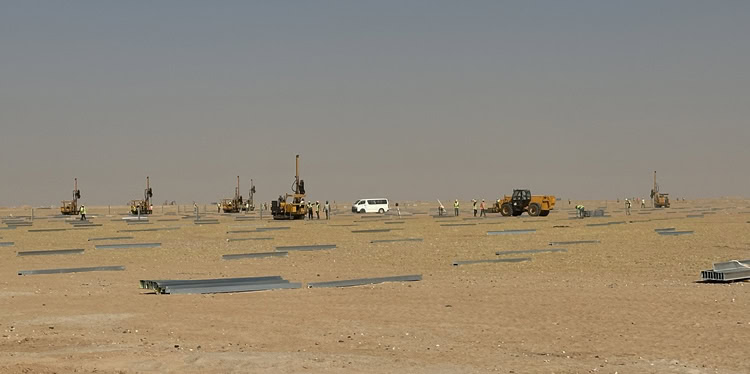
Loose and sandy soils allow solar pile driving machines to penetrate quickly. This is one reason large solar farms on sandy terrain often achieve peak daily output.
However, speed in loose ground comes with trade-offs. Without sufficient lateral resistance, pile alignment requires closer monitoring to ensure the correct angle and depth.
In sandy conditions, teams benefit from alignment reference points at regular intervals, GPS tracking of pile positions, and fixed-point positioning checks built into the installation sequence.
This captures the efficiency advantage without introducing structural integrity issues that only appear after solar panel components are mounted.
Layout Decisions That Directly Affect Daily Output
How a site is laid out determines how efficiently a solar pile driver moves between positions, how quickly operators track progress, and whether project timelines stay achievable.
This stage is also critical for enhancing efficiency across the entire installation workflow, as better coordination between equipment mobility, pile positioning, and crew allocation reduces downtime.
Making effective plans in advance ensures solar panel support structures are properly installed, and the different types of equipment are selected for each zone.
Accurate pile driving guarantees better alignment of all solar components, from mounting structures to panels.
Field Access Planning: Avoiding Machine Congestion on Active Sites
Access route planning is one of the most overlooked efficiency factors in solar pile driver operations.
On large solar farms where multiple pile driver machines run simultaneously, poor maneuvering coordination creates bottlenecks that reduce daily output regardless of individual machine performance.
For ramming machine solar operations, it is crucial to assess the loading requirements, machine width and length, and transported solar panel components, as well as adherence to Occupational Safety and Health Administration (OSHA) safety standards to protect workers during transportation and installation.
Well-defined delivery routes also help prevent interference between incoming materials, active pile driving zones, and support equipment movement across the site.
This is especially important when lifting operations are taking place near rows of solar panels or material staging areas, where safe spacing must be maintained at all times.
Pile Sequence Logic: A Practical Installation Order to Reduce Repositioning
How piles are sequenced across a site directly impacts how far the pile driver travels between driving positions. A disorganized installation order adds repositioning time and transport distance that cannot be recovered.
Row-by-row sequencing typically minimizes total travel distance, optimizes pile loading logistics, and helps reduce costs over the course of a project.
Modern solar installations demand fast, precise, and safe pile driving solutions.
When Ramming Is the Right Installation Method

Solar pile installations can be completed through ramming, drilling, or screwing. The right choice depends on site conditions, project scale, and the type of ground.
For flat-terrain solar farms working with 3–6m piles in compliant soil, impact ramming consistently outperforms the alternatives in speed and operational simplicity.
Ramming is the preferred method for constructing solar power stations and installing solar panels in large-scale solar energy projects, where efficient and stable pile driver foundations are critical for the long-term reliability of solar power systems.
Ramming machine solar operations leave the surrounding soil largely undisturbed, causing minimal disruption and avoiding the carbon footprint associated with concrete pouring.
By eliminating the need to prepare, transport, and cure concrete, pile drivers reduce the number of components requiring on-site management and simplify construction logistics in the solar power and renewable energy sector.
Flat Terrain as a Performance Prerequisite
EVERSTAR’s solar pile drivers are engineered for flat, level ground.
Installation can be difficult on uneven terrain, as slopes and inclines introduce both mechanical risk and safety concerns. Proper support structures are essential to hold solar panels securely in place, ensuring stability, optimal solar power output, and consistent energy generation for each array.
Terrain assessment must be part of the pre-mobilization site check, and sites with significant grade changes require a different equipment approach.
Balancing Installation Speed With Pile Accuracy
Speed and accuracy are complementary and efficient outcomes of the same preparation. Pushing for maximum daily output without accounting for ground resistance and alignment checks creates rework that costs more than the speed gain was worth.
In more advanced projects, automation can further improve consistency by helping crews monitor alignment, driving depth, and installation pace in real time.
Mounting systems for solar panels depend on piles being installed within defined tolerances. A pile driven at the wrong angle or to the wrong depth affects the entire row of solar panels above it, adding additional costs and disrupting delivery timelines for subsequent installation phases.
Ongoing maintenance and reliability are crucial for optimal solar power system performance, and drones are essential tools for site surveying, construction monitoring, and maintenance, providing high-resolution imaging and thermal scanning.
FAQs — Solar Farm Construction Equipment
When is impact ramming a better choice than drilling or screwing for solar foundations?
Impact ramming is generally preferred on flat terrain, where 3–6m piles are installed in compliant soil. It delivers faster penetration speeds and simpler operations compared to drilling or screwing. Our ramming machine is designed specifically for large scale solar farms, handling high volumes of pile driving with precision.
Can EVERSTAR solar pile drivers work in all soil types?
EVERSTAR solar ramming machines operate efficiently across a range of soil conditions, including sandy, clay, and mixed soils, ensuring consistent solar power output regardless of ground type. Ground conditions affect installation speed and the approach required: sandy soils allow faster penetration, while clay demands a more controlled process.
Plan Your Solar Farm Foundation With EVERSTAR Machinery’s Specialists
Every solar farm site is different: soil conditions, layout scale, terrain, transport logistics — all shape the right pile installation strategy for renewable energy projects.
Contact EVERSTAR’s specialists today to discuss your solar power project requirements and request guidance on building a site plan that supports reliable and specialized equipment for solar pile driving operations from day one.

