
Key Takeaways
- Ground condition is the primary filter for skid steer attachments; using the wrong fork types reduces efficiency throughout the day.
- Standard pallet forks work best on hard, flat ground, while soft or uneven terrain requires grapple or wide-stance attachments.
- Root grapples and grapple rakes outperform pallet forks for irregular, bulk, or loose material where tines lose control.
- The universal quick-attach system lets one skid steer swap pallets, grapples, buckets, and snow attachments without machine changeover.
- Always verify hydraulic flow and pressure before using powered attachments like brush cutters and severe duty grapples.
A skid steer’s output depends as much on attachment choice as on machine capability, since the ideal fork for a flat construction yard differs from that for muddy sites or brush-heavy areas.
Choosing attachments without considering ground conditions and task type lowers output, increases wear, and wastes time repositioning.
This guide covers skid steer attachments by ground condition and task type, ranging from standard pallet forks on compacted surfaces to severe duty grapple configurations on rugged terrain.
Ground Condition as the Primary Variable in Fork Attachment Selection
Surface stability, moisture, and terrain type dictate which skid steer attachment operates effectively. Pallet forks on graded surfaces move pallets with precise, repeatable cycles, but on soft ground, tine control and capacity drop significantly.
Ground condition is the first filter before selecting forks, buckets, or grapples because using the wrong attachment creates inefficiency across all loads during the day.
Hard and Compacted Ground: Standard and Heavy Duty Pallet Forks
On hard, compacted, or graded surfaces, pallet forks provide predictable load transfer for steel, lumber, and construction pallets, making these attachments suitable for moving pallets and structured loads in yards, driveways, and staging areas.
Fork tine length affects capacity for heavy pallet loads, and heavy duty pallet forks with heat-treated forks and oversized pins suit dense materials well.
Adjustable widths fit most pallets without swapping frames, so frame choice should match pallet widths used regularly. Heavy duty frames are best for dense construction material.
Soft and Uneven Ground: Root Grapples, Grapple Rakes, and Ground Pressure
Standard pallet forks lose effectiveness on soft, muddy, or uneven terrain, whereas grapples and root grapples secure irregular loads from above, holding debris, timber, and pipe firmly.
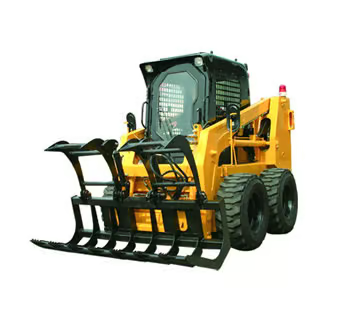
Root grapple frames come in heavy duty and economy grades with widths from narrow to wide for bulk handling, and they mount via universal quick-attach while connecting to auxiliary hydraulics when powered closure is needed.
Grapple rakes efficiently handle mixed debris where buckets spill or fail to grab, and they are available in heavy duty and economy grades with various widths and cutting edges, allowing them to handle light materials like leaves and mulch as well as heavy bulk loads.
Heavy duty grapple rakes use reinforced steel frames and stronger cylinders for continuous abrasive use, and grapples suit property clearance, land grading, and loose material handling where pallet tines lose loads.
Task-Type Matching: Selecting the Right Fork Configuration for the Job
Load shape and material type determine the fork configuration after ground condition is set. For example, standard duty pallet forks are ideal for handling uniform, palletized loads on stable, compacted ground, providing reliable support and efficient load transfer.
In contrast, irregular or loose materials such as brush, timber, or demolition debris require grapple forks or root rakes that can securely grasp and contain the load, especially on uneven or soft terrain.
Additionally, specialized attachments like double adjustable hay spears extend skid steer versatility for agricultural tasks, accommodating various bale sizes with secure handling.
Considering the continuous cutting capacity and brush cutting needs is essential when selecting attachments for vegetation management.
Pallet and Structured Load Handling: When Standard Forks Perform Best

Standard pallet forks excel at palletized material handling on stable ground, and tasks like equipment staging on solar farms and structured load transport in construction yards benefit from standard fork geometry. Adjustable widths fit standard and euro pallets without frame changes.
Double or quadruple hay spears extend skid steer use to agriculture by handling hay bales alongside pallets.
Hay spears and frames come in multiple sizes, adding versatility, while low-profile spears suit limited clearance and heavy duty spears secure bales reliably. Three-point and wide-angle spears increase reach across stacked bales.
Irregular and Bulk Load Handling: Grapple Forks, Severe Duty Grapples, and Brush Cutters
Grapples and root grapples outperform pallet forks for debris clearance, timber, manure, and demolition spoil, while severe duty grapples handle rock, concrete, dense brush, large timber, and mixed spoil. They feature heavy steel frames and high-capacity hydraulic cylinders for continuous abrasive use.
Brush cutters address brush cutting beyond grapple capability, and their performance depends on skid steer hydraulic flow and cutting capacity ratings.
Using brush cutters beyond hydraulic specs reduces performance, so keep brush cutters within rated hydraulic ranges to protect auxiliary systems. Snow removal adds attachments like snow buckets, blades, and grapple buckets for clearing driveways, roads, and ditches, with hardened steel edges improving snow clearing efficiency over economy pushers.
Attachment Compatibility, Quick-Attach Systems, and Field Swap Efficiency
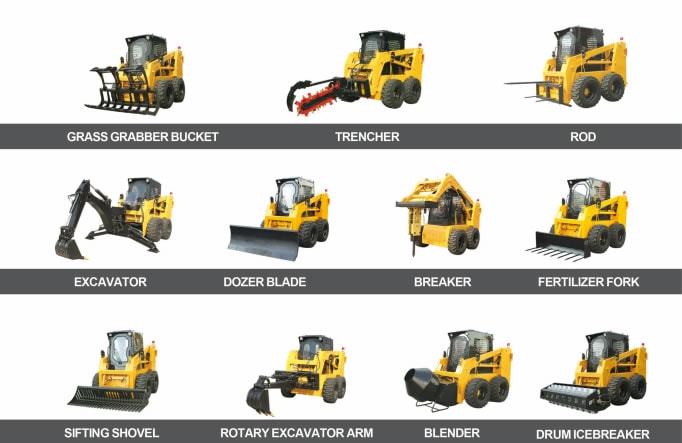
The universal quick-attach system lets most skid steer attachments mount across compatible brands, allowing a single skid steer to switch between pallets, grapples, buckets, vegetation buckets, snow buckets, and grapple buckets in one day, making it highly versatile.
Root grapple buckets, pallet fork frames, grapple buckets, and vegetation buckets serve distinct tasks within the same day.
Universal Quick-Attach Compatibility: What It Covers and Where It Stops
Universal quick-attach covers mechanical mounting but not hydraulic compatibility. Powered attachments like severe duty grapples, grapple rakes, and brush cutters need auxiliary hydraulic flow, and flow rates, pressure, and pull capacity vary, so they must be checked against skid steer specs before purchase.
Heavy duty skid steer attachments have oversized pins and reinforced frames for higher loads but require a skid steer with sufficient rated operating capacity.
Confirm rated capacity against attachment load before use since exceeding capacity risks frame damage and unsafe tipping loads.
Field Attachment Swaps: Quick Work When the Ground Is Prepared
Attachment swaps are fast when the skid steer is on stable ground.
For powered attachments, relieve hydraulic pressure before disconnecting lines, and secure detached attachments on stable ground before connecting replacements.
Enable hydraulics only after confirming attachment security. Planning swap frequency reduces transition time on sites using multiple attachments daily, while keeping connections clean and sequential eases attachment changes.
FAQ — Skid Steer Forks and Attachments
What is the difference between pallet forks and grapple forks on a skid steer loader?
Pallet forks have two tines that slide under pallets and structured loads on stable ground, whereas grapple forks add a hydraulic upper jaw securing irregular, loose, or bulk material. Pallet forks suit building supplies on hard surfaces, while grapple forks handle debris, brush, manure, timber, and unstructured loads on varied terrain.
What compatibility checks are required before using a hydraulic attachment on a skid steer?
Check skid steer auxiliary hydraulic flow rate and max operating pressure against attachment needs, and confirm auxiliary connection types match couplers. Attachments like brush cutters, severe duty grapples, and grapple rakes need specific hydraulic specs. Using them beyond skid steer limits reduces performance and risks system damage.
The Right Fork Attachment Starts with the Ground, Not the Load
Stable ground supports standard and heavy duty pallet forks, while soft, uneven, or mixed terrain requires grapple or root grapple attachments.
Load structure and material type determine fork choice within ground condition limits, and the universal quick-attach system lets one skid steer serve multiple tasks without machine change, making attachment selection key for productivity.
According to the U.S. Bureau of Labor Statistics, many construction equipment incidents stem from mismatched load capacity and ground conditions.
Contact EVERSTAR for Equipment Guidance on Your Site’s Ground Conditions and Task Profile
Construction contractors, solar farm equipment managers, and site teams can view the EVERSTAR site for more information on solar pile drivers, aerial work platforms, and scissor lifts, matched to ground conditions, access limits, and tasks.
Contact EVERSTAR to discuss your site profile and get equipment recommendations tailored to your ground and project needs.

