
Learn how to choose the right hydraulic hammer for H-beams, screw piles, and steel profiles. Maximize efficiency, stability, and speed in ground mount solar installations.
Key Takeaways
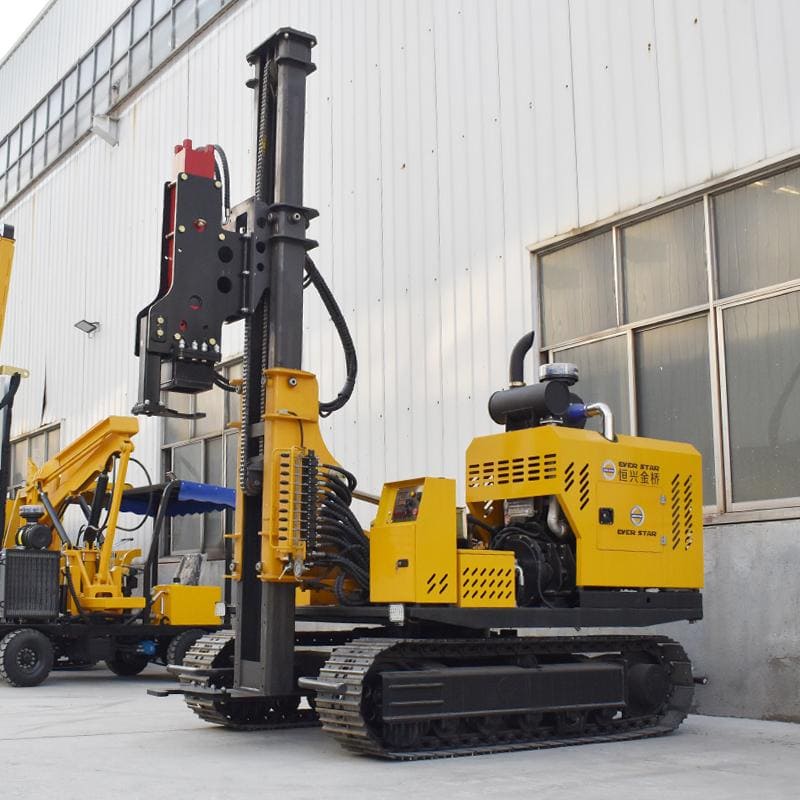
- In modern renewable energy projects, selecting and operating the right pile driver for complex geological conditions is crucial.
- A basic analysis of different pile types helps customers understand which pile is best suited to specific terrain and geological conditions, enabling them to select the most effective and durable foundation solution for their projects.
- EVERSTAR can customize pile caps to accommodate different pile types. By properly matching the hydraulic hammer’s performance with the pile cap dimensions, we ensure efficient energy transfer while preventing damage to both the pile head and the equipment.
In modern renewable energy construction, establishing robust pile foundations is a vital task for utility-scale solar installations. As the global solar industry experiences rapid growth, contractors must achieve high operational speed and precision across all projects. The structural stability of solar systems depends on properly selecting machinery and equipment tailored to variable ground conditions. Selecting the right hydraulic hammer on a pile driver plays a pivotal role in penetrating different soil profiles—from tough clay to hard rock. Leading manufacturers have developed specialized solar machines designed to lead the line in installation performance.
What Are the Different Types of Piles?
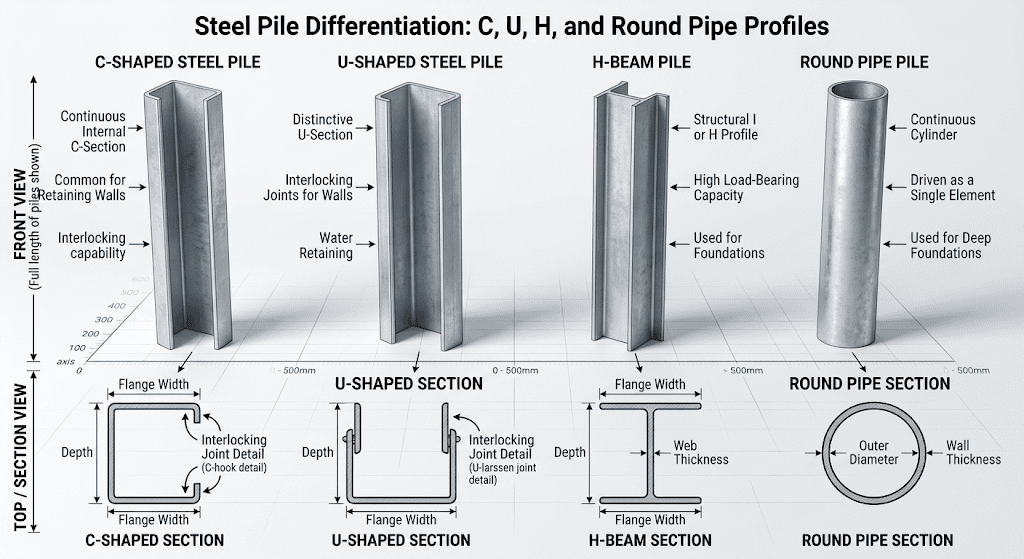
The first step is to identify the pile type, dimensions, material, and installation requirements. Common solar foundation piles include C-shaped piles, U-shaped piles, H-beam piles, and round pipe piles. Each profile has different structural characteristics that influence hammer selection and pile-cap design.
C-Shaped and U-Shaped Steel Piles
C-shaped and U-shaped steel piles are widely used in solar mounting structures because their profiles can provide useful structural strength while keeping material consumption relatively low. Their open sections, however, require suitable contact surfaces to distribute impact forces without damaging the pile edges or flanges.
When selecting a hydraulic hammer for these piles, check the cross-sectional dimensions, steel thickness, and pile-head geometry. The pile cap should fit securely and transfer impact forces appropriately. An incorrectly sized cap may cause uneven contact, deformation, or unstable pile driving.
H-Beam Piles
H-beam piles are often selected for projects that require substantial structural support. Their flanges and web create a different load-transfer pattern from that of open-channel piles.
The hammer and pile cap should be compatible with the beam’s flange width, web dimensions, and overall section size. Stable alignment is especially important because uneven impact can damage the pile head or cause the pile to deviate from its intended position.
Round Pipe Piles
Round pipe piles are used in some solar foundation designs because their closed cross-section provides useful resistance to bending and torsional loads. They require a pile cap or adapter designed for the pipe’s diameter and end geometry.
Before operation, verify that the cap fits properly and remains centered during impact. The pipe wall thickness and material strength should also be considered to reduce the risk of local deformation. A round pipe pile should not be driven with an improvised adapter that fails to provide stable contact.
Pile Foundations: How to Choose the Right Pile Cap?
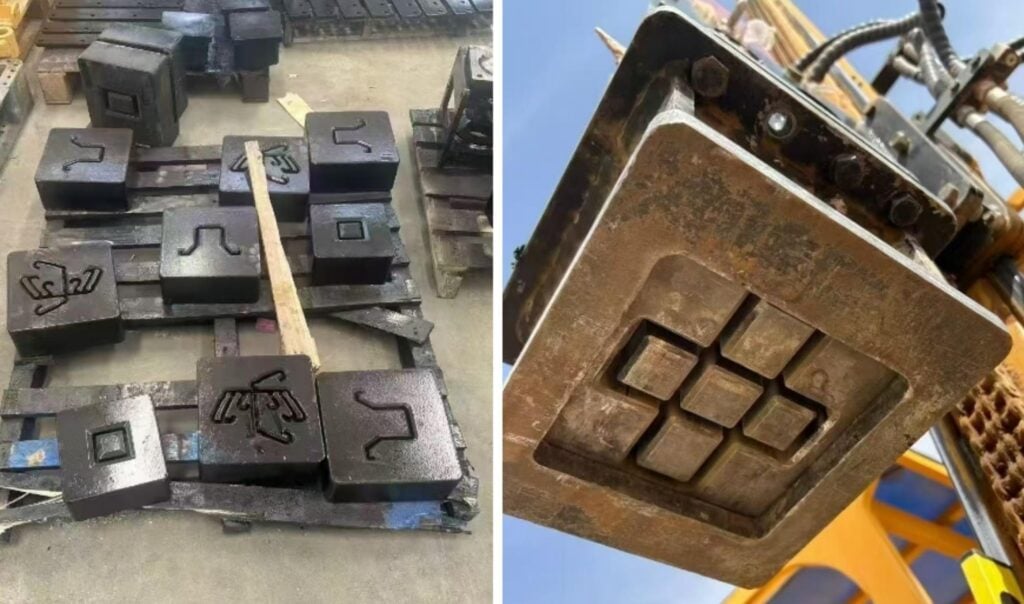
EVERSTAR can customize pile caps in various shapes to accommodate different pile shapes and sizes, meeting the specific requirements of each customer’s project.
A hydraulic hammer delivers repeated impact energy to drive a pile into the ground. The pile cap or connection adapter transfers that energy to the pile head. Both components must be selected together to ensure stable contact and effective energy transfer.
Start by measuring the pile’s cross-sectional dimensions, wall thickness, and head geometry. Then confirm that the pile cap is designed for the specific profile. The cap should fit securely, remain aligned during operation, and avoid concentrating impact loads on vulnerable edges or thin sections.
Hammer performance must also be appropriate for the pile and ground conditions. Insufficient impact performance may lead to slow penetration, while an unsuitable impact setting or poorly matched cap may increase the risk of pile-head damage and equipment stress.
| Pile type | What to check | Selection guidance (project-level; confirm with manufacturer) |
| C / U steel section | Section width, depth, flange/web geometry, wall thickness | Use a profile-matched cap or adapter that supports the intended load path and avoids concentrated loading or slipping. |
| H-beam / I-section | Flange width and thickness, web geometry, pile length | Check that the cap locates securely on the section and that impact is transferred without damaging flanges or web. |
| Round steel pipe | Outside diameter, wall thickness, end condition | Use a correctly sized pipe cap/adapter with proper alignment; inspect the pipe end for deformation during driving. |
| Other proprietary / formed profiles | Manufacturer drawing, tolerances, connection details | Obtain an approved custom or dedicated adapter rather than improvising a fit. |
Pile Driving: How to Choose the Right Hydraulic Hammer?
Choosing the appropriate hammer requires evaluating both the target piles and the soil characteristics. For standard steel piles driven deep into the ground, a high-power hydraulic hammer offers an efficient solution. Unlike heavy concrete foundations used in traditional buildings or bridges, solar structure supports frequently require controlled impact energy to avoid damaging the profile heads. The ability of modern driving methods to adjust force based on weight and required power ensures high efficiency during installation. When working in tough clay or dense terrain, limited resistance can be overcome through precise stroke control.
To choose the optimal driving unit for your solar pile driving setup, consult the performance parameters listed below:
| Item | Manual value / statement |
| Impact frequency | 800 Bmp (as printed in the manual) |
| Impact energy | 1,200–1,800 J in the technical-parameter table |
| Impact power statement | Up to 1,950 J in the product-features section |
| Hydraulic system pressure | 19 MPa |
| Engine options | Yanmar 4TNV98CT (Euro 5), 53.7 kW; Cummins QSB3.9 C130-30, 97 kW |
| Maximum pile-driving depth | 3, 4, 5 or 6 m, depending on configuration |
| Drill rod diameter | Φ75, Φ85 or Φ100 mm |
| Feed system maximum propulsion force | 60 kN |
| Feed system maximum lifting force | 130 kN |
| Power-head torque / speed | 6,000 / 8,000 Nm; 70 / 140 r/min (table lists paired values) |
Through sustainable manufacturing and innovative engineering, top machinery manufacturers generally deliver versatile pile driver solar units built to elevate efficiency and stability in every project.
FAQs
Can the same hydraulic hammer be used for both H-beam and screw piles in solar projects?
Generally, no. Different solar pile types require distinct attachment methods and impact profiles. While an H-beam pile demands a heavy-duty hydraulic hammer with high impact energy to drive structural steel deep into hard ground conditions, screw piles rely on rotational torque rather than linear percussive force. Using the incorrect equipment can lead to diminished efficiency, premature tool wear, or structural damage to the piles.
How do soil conditions affect the selection of a pile driver for solar installations?
Soil composition dictates the required driving power and impact class of your pile driver. For instance, dense cohesive soils like clay or rocky terrain demand higher impact frequency and robust machinery to maintain optimal speed and stability during installation. Evaluating the geotechnical report beforehand ensures contractors choose a reliable solution that maximizes project efficiency.
Contact EVERSTAR for High Quality Machines
Have questions about choosing the right hydraulic hammer for your solar pile driving project? Contact our engineering team today to get custom machinery recommendations, technical support, or a competitive quote.

