
Learn the key challenges and solutions for pile driving on uneven terrain, including ground preparation, positioning, vertical alignment, and feed control.

Key Takeaways
- Advanced crawler-mounted solar pile drivers offer key advantages in solar power plant construction. With proper site leveling and precise operation, they can handle complex terrain conditions while maintaining efficient and reliable piling performance.
- Complex and uneven terrain can significantly affect solar pile driving efficiency and accuracy, making proper site leveling and preparation an essential part of the piling process.
- These five methods and practical measures provide effective solutions for dealing with challenges such as uneven construction sites, helping solar pile drivers maintain stable performance and complete piling tasks efficiently.
Executing successful solar farm projects often means tackling demanding landscapes and unpredictable ground conditions. Standard, flat topography is increasingly rare, forcing contractors to perform solar pile installations on rough, uneven terrain. Facing varying soil conditions, steep slopes, and rocky obstacles can slow down productivity and increase labor requirements when relying on traditional methods. To overcome these factors and ensure long-term structural stability, modern utility-scale solar projects require specialized, robust equipment that offers both power and precision.
Benefits and Advantages of Advanced Solar Equipment
Choosing top-tier pile drivers equipped with modern features transforms the entire installation process. Key benefits and advantages include:
- Enhanced Efficiency and Speed: Accelerates solar pile deployment to meet tight project schedules with shorter lead times.
- Unmatched Stability and Precision: High-performing models ensure every solar panel support structure is installed with millimeter precision, regardless of the ground slope.
- Cost-Effective Investment: Streamlined serviceability, reduced labor requirements, and lower maintenance costs make these machines a highly profitable investment for long-term project success.
With the ability to master a diverse range of challenging topographies, modern solar pile driver machinery delivers the perfect balance of power, efficiency, and control required for today’s high-stakes solar developments.
Pile driving is an important part of photovoltaic power station construction, especially when large numbers of fixed piles need to be installed efficiently. However, ground conditions can directly affect the stability, positioning, and operation of a pile driver. When the working surface is uneven or insufficiently supported, maintaining accurate pile positioning and vertical alignment can become more challenging.
For this reason, proper site preparation and equipment adjustment are essential before starting pile driving. The HX-R6 crawler photovoltaic pile driver manual emphasizes the importance of a flat and solid working surface, secure track support, accurate hole positioning, vertical alignment, and controlled feeding during operation.
Why Does Uneven Terrain Affect Pile Driving?
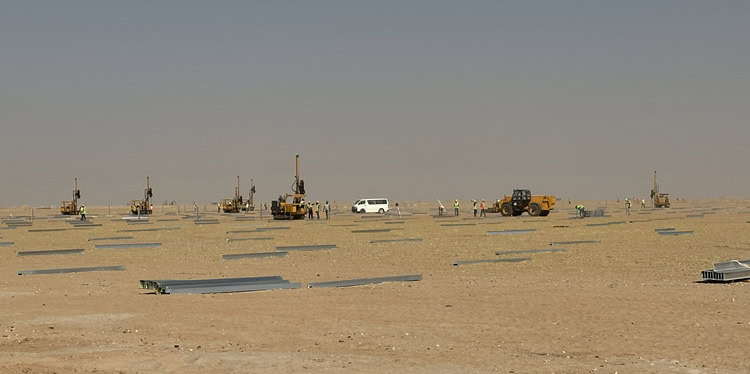
When driving piles into irregular ground, achieving exact depth and correct pile positioning becomes a significant challenge. Without the right technology, operators face reduced speed, accuracy loss, and higher risk of operational downtime. Irregular terrain places extreme demands on structural materials and machinery. Traditional driving methods lack the specialized control and adaptability necessary to maintain high quality standards, leading to extended project timelines and bloated budgets.
Uneven ground can make it more difficult to keep the machine firmly supported. It can also increase the difficulty of accurately positioning the pile and maintaining the vertical relationship between the pile column and feed beam.
Therefore, ground preparation should be regarded as an important part of the pile driving process rather than simply a preliminary step.
Advanced Solutions: How to Address These Challenges?
To address these difficulties, investing in a high-performance solar pile driver machine provides the ultimate solution. Engineered specifically for rugged environments, a solar pile driver features a flexible, dynamic mast and state-of-the-art hydraulic components designed to deliver optimal impact energy through an integrated hydraulic hammer. These high quality pile drivers ensure superior accuracy and structural durability, allowing teams to evaluate complex ground dynamics and adapt in real time.
1. Ensure a Stable Working Surface
The first challenge when operating a pile driver on uneven terrain is equipment stability.
The technicians states that before operation, the machine must be firmly in contact with the support surface. The support surface should be as flat as possible, there should be no track overhang, and the maximum slope should not exceed 2°. When necessary, steel plates or sleepers should be laid.
These requirements provide a practical approach to preparing the work area:
- Keep the working surface as flat and solid as possible.
- Make sure the crawler tracks are properly supported.
- Avoid track overhang.
- Keep the slope within the specified 2° limit.
- Use steel plates or sleepers when additional support is required.
- Prevent the machine from sinking into the ground.
A properly supported pile driver provides a more stable foundation for subsequent positioning and pile driving operations.
2. Position the Pile Driver Accurately
After establishing a suitable working surface, the next challenge is accurate pile positioning.
The operator describes pile driving as involving positioning followed by pile driving. During the positioning process, the pile driver is driven into the leveled site using the travel handle. The control guide rail and fine-tuning handle are then used to align the hole position.
This means that positioning should not be treated as a single movement. The machine first needs to reach the prepared work area, after which the operator can make finer adjustments to achieve the required hole position.
Accurate positioning is particularly important for photovoltaic projects because piles are normally installed according to a planned layout. A consistent positioning process helps operators establish each pile at the intended location before the hydraulic impactor begins the pile driving operation.
3. Maintain Vertical Alignment Before Pile Driving
Maintaining vertical alignment is another important challenge.
Before driving a pile, the engineer requires the pile column and feed beam to be in a vertical state. The operator can adjust verticality in the front-to-back direction using the designated handle and adjust the left-to-right direction using the slide swing handle. The vertical condition should then be confirmed and adjusted using a physical level or electronic level.
This gives operators a clear sequence:
Position the machine → align the hole → adjust verticality → verify the level → begin pile driving.
This sequence is especially important when the working surface is not perfectly level. Instead of immediately starting the impact operation, the operator should first make the necessary positional and vertical adjustments.
The operator also states that the slideway and frame must be firmly connected during equipment operation. This requirement is related to equipment safety and should be checked before continuing the work.
4. Control the Feeding Speed Properly
Once the pile driver has been positioned and aligned, feeding control becomes another important part of the operation.
The R6 pile driver uses the power head lifting/feeding handle to control the upward and downward movement of the power head. The swing amplitude of the handle provides stepless speed control: a larger swing amplitude results in a faster movement speed.
However, the technicians specifically recommend gradually increasing the feed handle from a small swing to a larger swing during pile driving or drilling. Operators should match the feed speed to the working conditions rather than immediately moving the handle to its maximum position, because doing so may damage the drill bit or impactor.
This is particularly relevant when working conditions require careful equipment adjustment. Controlled feeding allows the operator to gradually establish an appropriate operating speed.
5. Use the Correct Pile Driving Sequence
The R6 hydraulic photovoltaic pile driver uses high-frequency hydraulic impact for pile driving. The basic process consists of positioning the pile column, starting the hydraulic impactor, and controlling the feed cylinder until the pile reaches the specified depth.
A practical operating sequence based on the manual is therefore:
- Prepare a flat and solid working surface.
- Provide additional support with steel plates or sleepers if necessary.
- Move the pile driver into the leveled work area.
- Align the required hole position using the guide rail and fine-tuning handle.
- Check the verticality of the pile column and feed beam.
- Adjust verticality in both directions.
- Confirm the vertical condition with a physical or electronic level.
- Firmly connect the slideway and frame.
- Start the hydraulic impactor.
- Gradually control the feed speed until the pile reaches the required depth.
Following this sequence helps separate positioning, alignment, and pile driving into controlled steps.
FAQs——Ground conditions
Can a pile driver work on uneven terrain?
A pile driver should be operated on a flat and solid working surface whenever possible. According to the HX-R6 User Manual, the support surface should be as flat as possible, the track should have no overhang, and the maximum slope should not exceed 2°. If additional support is needed, steel plates or sleepers can be laid to help prevent the machine from sinking.
How do you keep piles vertical when driving on uneven ground?
Before pile driving, the pile column and feed beam should be adjusted to a vertical position. The operator can adjust the front-to-back and left-to-right verticality using the corresponding controls, then confirm the position with a physical level or electronic level. The hole position should also be aligned using the guide rail and fine-tuning handle before starting the pile driving operation.
Contact EVERSTAR for High Quality Pile Drivers
Looking for a reliable solution for photovoltaic pile driving on challenging terrain? Contact EVERSTAR for professional pile driver solutions and technical support.

