
Key Takeaways
- Grease the stabilizer, swing, boom, and loader pivots daily, since they carry the greatest load.
- Wet or gritty soil wears down teeth, cutting edges, hoses, and cylinder rods faster.
- EVERSTAR’s maintenance schedule sets engine oil changes at 250-500 hours and hydraulic fluid changes at 1,000-2,000.
- Remote crews should keep a small parts stock for their specific model.
- Have the model, serial number, and part location ready when you order parts.
Imagine a drainage crew three hours into a trench when the backhoe starts knocking on every swing. By noon a dry pin has worn its bushing oval, and the backhoe loader sits idle while someone fetches parts. A two-minute grease check at shift start would have caught it.
This backhoe loader maintenance guide is for owners and mechanics who service their own EVERSTAR E3CXL and E4CX machines.
Backhoe-Specific Wear Points: A Maintenance Checklist and Component Guide
With attachments at both ends, a backhoe loader has more pivots, pins, and hoses than most machines, and that is where unplanned downtime usually starts. Pre-shift items are covered in EVERSTAR’s backhoe loader safety guide; this checklist covers wear and maintenance. Work in a clean, ventilated area and tag the machine ‘DO NOT OPERATE’ first.
Stabilizers, Pivots, and Bushings: Inspection and Greasing Points
Check these points before every shift:
- Stabilizer legs and cylinders: bent legs, scored rods, leaking seals, and cracks at the brackets. The stabilizers lift the rear wheels during digging, so one weak leg will make the backhoe rock.
- Swing and boom pivots: knocking when you operate the swing, and fittings that do not accept grease.
- Loader pivots, pins, and bushings: side play, oval bores, and pins that move under load.
Grease the main pivots daily or every 10 operating hours, and more often in harsh conditions. Wipe the fitting clean and pump until new grease pushes the old out. A fitting that will not take grease means a dry pin; log it and fix it before the backhoe loader returns to operation.
Buckets, Teeth, and Hoses: Wear Checks After Digging and Loading
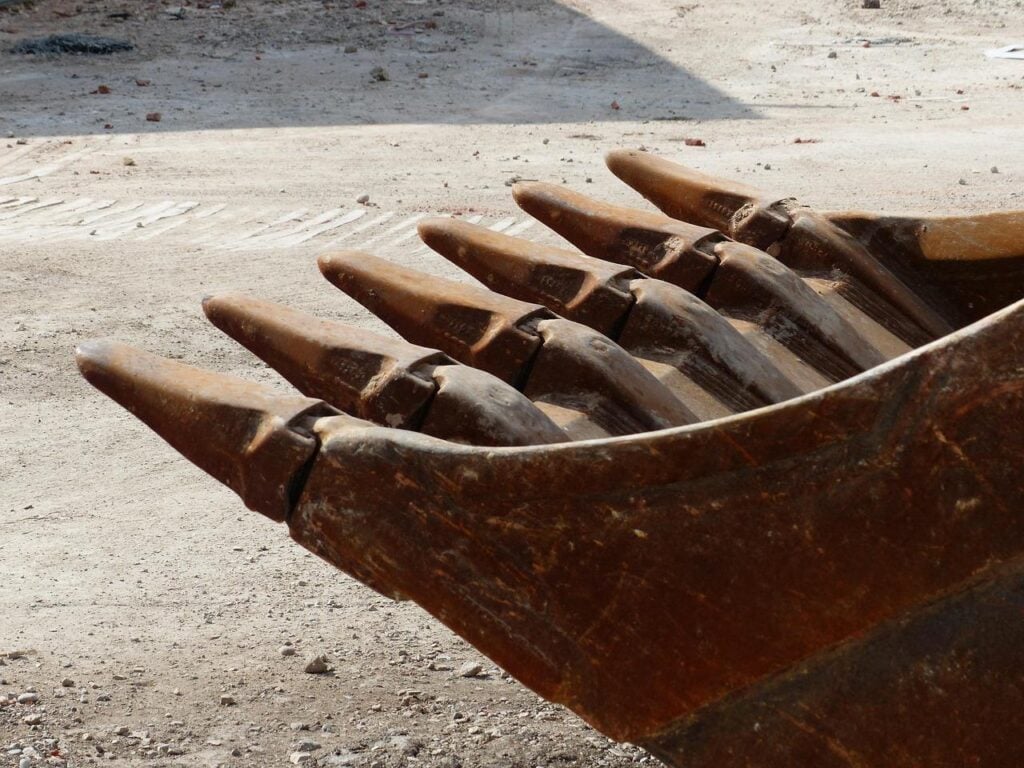
Check the cutting edge and teeth after each digging day. Rounded tips make the machine work harder, and teeth worn to the adapter mean paying for a larger part. EVERSTAR’s bucket size and capacity guide explains how to match the bucket to the material.
Hoses wear where they cross the boom and dipper at full reach; check for worn covers, damp fittings, and kinks. Clean the cylinder rods too, since one scratch can damage a seal.
Sand, gravel, and wet clay shorten every wear interval. Mud packs into the linkage and holds water against the steel, so clean and grease the backhoe loader after a muddy shift.
Scheduled Service Intervals for the E3CXL and E4CX
Fluids, filters, and seals wear out over time, and the table below groups each hour-based maintenance task by system, using EVERSTAR’s published Verify each figure against the operator manual for your serial number.
| Pivots and pins | Grease loader, boom, swing, stabilizer, and bucket pins | Daily or 10 hours |
| Engine and fuel | Check oil and coolant; drain the fuel-water separator | Daily |
| Hydraulics and tires | Check fluid level, hose leaks, tire pressure, and wheel nuts | Daily |
| Attachments | Grease auxiliary attachments and wear pads | 50-100 hours |
| Engine | Clean or replace the air filter; check belt tension and battery | 50-100 hours |
| Engine and fuel | Change engine oil, oil filter, and fuel filters | 250-500 hours |
| Driveline and structure | Check transmission and axle oil; inspect stabilizers and boom latch | 250-500 hours |
| Hydraulics | Replace hydraulic fluid and filters | 1,000-2,000 hours |
| Driveline and cooling | Change transmission and axle oil; flush the coolant | 1,000-2,000 hours |
| Structure | Inspect welds for fatigue cracks | 1,000-2,000 hours |
Engine and Filter Service: Oil, Air, Fuel Filter, and Belt Tension Schedule
The E3CXL is fitted with a Yuchai YCD4J22T-115 engine (85 kW) while the E4CX has a Yuchai 4-108 (75 kW). Oil and filter changes are the most common form of maintenance for both models, according to the manual, and should be carried out every 250 to 500 hours. The fuel filters should also be changed during the same visit as this helps to keep both dirt and water away from the injectors.
Dust is hard on air filters and therefore 50 to 100 hours is the maximum time allowed. When operating in dusty conditions, the restriction indicator should be checked every shift and the housing cleaned before opening it. If the belt is loose it will squeal when the machine is started and will cause the coolant temperature to rise. The belt should be checked each time the filter is changed.
Hydraulic System and 4WD Driveline: Fluid, Seals, and Axle Care
Almost all of the operations carried out by a backhoe loader are controlled by the hydraulics. The E3CXL uses 100 litres of hydraulic oil, while the E4CX uses 150 litres, and the E3CXL has four external test ports which facilitate diagnostic maintenance. Make sure that the fill caps and breathers are kept clean so that grit will not get to the pump.
A seal leak begins with a damp film on the rod and then progresses to dripping; this is also how axle seals on the 4WD driveline behave.
When you come to these warning signs, do not operate the backhoe loader: if the hydraulic fluid is milky, if fluid is spraying from a fitting, if there is a sudden decrease in digging power, if the axle is grinding, or if there is a transmission warning. Before opening any line, release the hydraulic pressure in accordance with OSHA’s guidance on stored energy.
Spare Parts Planning for Backhoe Loaders
Match a short parts list to each backhoe loader since this helps to reduce downtime and ensures that the maintenance budget remains efficient. Keep all the fast-wearing parts in stock and place orders for the rest when required. Pumps, cylinders, starters, and tyres rarely fail and would cost too much to keep aside.
Wear Parts to Stock: Filters, Teeth, Pins, Bushings, and Hoses
| Filters (oil, fuel, air, hydraulic) | Used at every service | Scheduled maintenance stalls |
| Bucket teeth and retaining pins | High in abrasive soil | Digging slows or stops |
| Hydraulic hoses | Low to moderate | Machine stops until replaced |
| Pins and bushings | Slow | Long lead time; wear spreads to the bore |
When your crews work a long way from a supplier, it’s important to have a sufficient stock of filters, teeth, and spare swing and boom pins. You should also include the most exposed hoses, grease, and the oil and hydraulic fluid needed for top-ups. If you’re using running attachments such as a breaker or an auger, then make sure you have spare hoses and couplers for those attachments as well.
FAQs – Backhoe Loader Maintenance
For the EVERSTAR E3CXL or E4CX, which parts require greasing most frequently?
The pivot points of the backhoe’s swing, boom, loader arm, bucket linkage and stabilizer should be greased every day or after every 10 hours of operation since these joints carry the greatest loads. Each fitting must be wiped clean and then greased by pumping until fresh grease appears. A operator’s manual produced by EVERSTAR Machinery shows all the greasing points according to model.
What spare parts should a small contractor have in stock for a backhoe loader?
Keep a full filter set, bucket teeth, the most exposed hoses, and spare swing and boom pins and bushings. Add engine oil, hydraulic fluid, coolant, and grease for top-ups. Send the model and serial number through the contact form for a quote.
Contact EVERSTAR for Backhoe Loader Service
E3CXL and E4CX owners can contact EVERSTAR for efficient operator manuals, maintenance interval confirmation, maintenance guidance, and parts support, including third-party documentation for attachments or components when it applies.

