
Solar Farm Post Driver Best Practices to Protect Soil

Key Takeaways
- Plan site preparation and traffic routes for solar farm pile drivers to avoid weak or saturated soil conditions.
- Configure Everstar solar pile driver machines to achieve low ground pressure on soft soils.
- Use outside-in pile driving sequences to preserve soil hydrology and reduce compaction.
- Activate rain contingency protocols with defined soil moisture triggers and temporary drainage solutions.
- Install erosion controls on day one and restore soils per Natural Resources Conservation Service (NRCS) standards after installation.
The installation process must protect soil structure while maintaining alignment, pile lengths, depth management, and production targets across large sites. Solar farms depend on strong solar pile foundations for solar panels and other industrial structures, installed efficiently by solar pile driver machine.
However, heavy pile driving equipment can damage soil structure and create demands if not managed correctly. Soil compaction, erosion, and drainage disruption not only threaten environmental compliance but also increase restoration costs and jeopardize landowner acceptance.
In the solar industry, utility scale solar installations require foundation systems that balance installation speed with soil stewardship. This article presents field-tested soil protection protocols for solar farm post driver operations, helping contractors exceed productivity targets while minimizing erosion, compaction, and compliance risk across a wide range of site conditions.
These best practices align with EVERSTAR’s solar foundation piling solutions, designed to protect soil integrity without sacrificing production efficiency.
Site Assessment for Post Driver Traffic Planning
Effective soil protection begins before equipment arrives onsite. Pre-mobilization planning allows construction teams to predict soil behavior, reduce risk, and avoid costly corrective work once pile driving begins.
Soil Classification and Bearing Capacity Mapping for Solar Foundations
Solar foundations require thorough terrain preparation to ensure stability for solar modules while minimizing disturbance. Geotechnical reports should be reviewed to establish trafficability zones and identify no-drive areas such as drainage swales, wetlands, and low-bearing soils.
Penetrometer testing helps verify firm zones suitable for equipment travel. Soft or wet areas should be reinforced with geotextile fabric and rock pads before post driver deployment. Proper mapping prevents rutting, protects soil structure, and supports rut-free solar pile installations.
Haul Road and Working Platform Specifications for Ground Mount Solar Projects
Well-designed access routes are critical for maintaining traction and minimizing ground disturbance, and supporting safe equipment transportation. Best practice specifications include:
- Minimum widths: 4–5 meters to accommodate solar pile driver machines
- Crown grades: 2–3% to promote surface drainage
- Subgrade reinforcement: Geotextile under stone in soft soils
- Turning clearances: Sized for machine swing and mast rotation
These measures ensure smooth pile driving process without deep rutting or loss of stability.
Machine Configuration for Minimal Ground Pressure

Solar post drivers must be configured correctly with adaptable settings to distribute weight evenly and adapt to a range of soil conditions across the site.
Outrigger pad sizing and placement protocols
Modern solar piling relies on specialized equipment designed to deliver durability across repeated pile installations and consistent force without overstressing the soil profile, adjusted to the specific needs of the site.
Outrigger loads concentrate machine weight, making pad sizing essential. Calculate required pad area using machine specifications and aim to keep ground pressure below 10 psi, especially on soft soils.
Timber mats or outrigger extensions should be used where bearing capacity is limited. Repositioning sequences must avoid overlapping pad placements to prevent cumulative compaction. Proper setup enhances the machine’s ability to operate safely on soft soils while minimizing compaction, maintaining productivity.
EVERSTAR’s hydraulic components deliver exceptional stability, low ground pressure, and unmatched product support.
Tire/track pressure adjustments for site conditions
Tire pressure and track tension should be adjusted before entering the site. Lower pressures improve flotation and reduce soil displacement. Daily checks are recommended, particularly during wet weather.
Typical targets include approximately 15 psi on sandy soils and 10 psi on clay. Proper adjustments prevent soil “pumping” during pile driving operations, even during thaw conditions, resulting in zero rut formation when protocols are followed.
Piling Sequence to Minimize Soil Disturbance
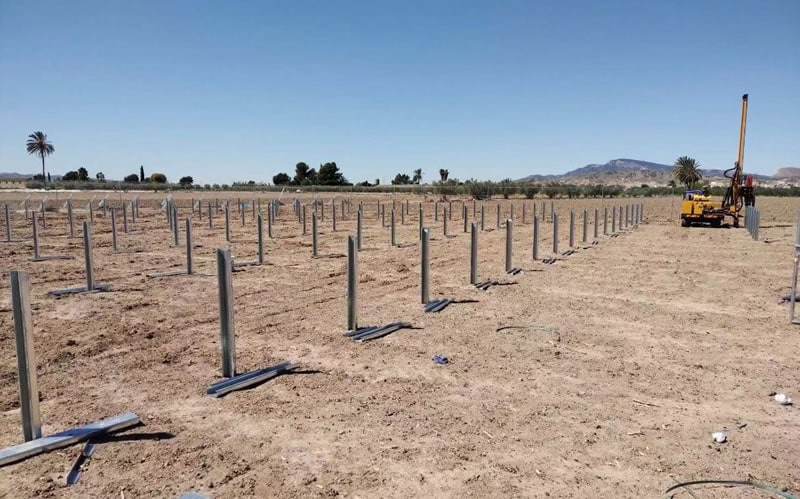
Strategic pile driving order preserves site hydrology and topsoil integrity.
“Outside-in” vs. row-by-row progression strategies
Sequencing decisions should balance installation speed with long-term structural integrity and drainage performance. An outside-in, perimeter-first approach protects interior soils by limiting repeated equipment traffic over completed areas. This strategy is ideal for slopes greater than 5% and sites prone to runoff or windrowing.
A row-by-row progression may be suitable for flat solar projects with uniform drainage and GPS-guided positioning. The optimal approach depends on drainage patterns, access constraints, and spoil management.
Turning radius and swing restrictions near wet areas
Turning and mast swinging near drainage features can destabilize soils. Establish 25-foot no-swing buffer zones around swales and wetlands. Spotters should guide tight maneuvers, and GPS exclusion zones can prevent boundary violations.
These practices have proven effective in maintaining dry zones at the jobsite terrain and in passing environmental inspections on the first attempt.
Soil moisture action plan triggers and thresholds
Daily soil monitoring should define clear stop-work thresholds. Work should pause when soil reaches a plasticity state where it molds without cracking or when penetrometer readings exceed 500 psi—commonly after 0.75 inches of rain on clay soils.
Resume work after 48 hours of drying and spot verification. Logging moisture data supports permit compliance and allows the pile installation to resume quickly without compromising soil structure.
Temporary Drainage and Dewatering Layouts
Temporary drainage systems help maintain access during wet periods. Best practices include:
- Constructing perimeter dirt berms at site edges
- Installing French drains with perforated pipe and gravel every 100 feet along haul roads
- Pumping low areas into vegetated swales
These measures can cut weather-related downtime in half.
Erosion Control Integration During Solar Pile Driving
Simultaneous BMP installation prevents post-construction sedimentation.
Silt fence and straw wattle placement timing
All erosion management should be installed and maintained in accordance with industry standards and local permitting requirements. Install 3-foot silt fences around the entire site before solar pile driver machines arrive. Ends should be keyed and hooked to prevent bypass. Straw wattles should be placed at slope breaks, with gravel check dams installed every 50 feet on downhill runs.
Inspect controls after every half-inch rainfall event. These efficient practices integrate seamlessly with Everstar workflows and prevent delays caused by sediment violations.
Post-Production Soil Restoration Standards
Final grading and seeding protocols to achieve landowner acceptance.
Compaction relief and seedbed preparation
After pile installation, compacted areas should be subsoiled to approximately 18 inches using a crisscross pattern. Incorporate organic compost at a rate of two tons per acre and harrow soil to achieve uniform, pea-sized tilth.
Seed with approved native grasses or a fescue-rye mix at approximately 100 pounds per acre. These steps meet NRCS standards and promote rapid vegetative establishment within a single growing season.
FAQs – Solar Foundation Piling Solutions
What is a pile foundation for solar panels?
A pile foundation uses steel beams or ground screws driven deep into the soil by a solar pile driver machine. These piles support solar racking systems without the need for concrete, reducing soil disturbance while providing long-term structural rigidity and durability for solar panels.
When should solar post-driver operations be suspended due to rain?
Operations should pause when soils become plastic and moldable without cracking or when penetrometer readings exceed 500 psi, typically after 0.75 inches of rainfall on clay soils. Work can resume after 48 hours of drying and verification checks.
What ground pressure is safe for solar farm pile drivers?
A ground pressure below 10 psi is considered safe for most solar sites. Crews should calculate machine weight distribution across pads, tracks, or tires. Mats and flotation aids help achieve this threshold and preserve soil infiltration capacity.
How to fix post driver ruts without delaying schedule?
Shallow ruts should be repaired the same day using site material placed in 4-inch lifts and compacted firmly. Geotextile fabric prevents recurring settlement. Deeper ruts may require subsoiling but can often be handled by off-shift crews without impacting production.
Conclusion: Soil Stewardship Builds Repeat Business
Soil protection, combined with installation efficiency, is a competitive advantage in pile solar construction. Contractors who adopt integrated foundation solutions—rather than treating piling as a standalone task—consistently achieve measurable cost-effective benefits, including better soil performance, smoother permitting, and more predictable project outcomes.
Demonstrating environmental responsibility alongside production efficiency positions teams as preferred partners for future projects. Everstar’s versatile lineup of solar pile driver machines and solar foundation piling solutions enable to meet performance demands while preserving the land they build on.
Talk to EVERSTAR’s Solar Post Driver Specialists
Ready to implement soil-smart piling on your next solar project? Connect to EVERSTAR today for a customized consultation on site-specific foundation solutions tailored to your solar farm operations. Talk with our specialists and see how EVERSTAR delivers reliable installation services without compromising the ground beneath it.

