
Key Takeaways
- Successful solar farm construction depends on disciplined workflow planning before pile drivers arrive at the job site.
- Accurate layout preparation ensures pile foundations are installed at the correct angle, spacing, and depth for long-term structural integrity.
- High-performance photovoltaic pile drivers can achieve excellent speed and efficiency when matched to site soil conditions and project sequencing.
- Continuous inspection during pile installation protects stability, supports industry standards, and reduces correction costs.
In utility-scale solar farm construction, outcomes are rarely determined solely by machine specifications. The success of a solar project depends on workflow decisions made before, during, and after machine operation.
A solar piling machine is most effective when integrated into a disciplined construction process that accounts for soil type, machine movement, operator coordination, and inspection sequencing.
For modern solar farm construction, achieving 200–300 piles per day is realistic only when workflow is treated as a structured operational system.
EVERSTAR’s advanced pile drivers are designed to meet the increasing demand for efficient installation across large solar fields, delivering the power, capacity, and operational speed required for utility-scale photovoltaic projects in today’s evolving renewable energy industry.
Layout Preparation Before the Machine Arrives on Site
Layout preparation directly determines how efficiently pile drivers operate once mobilized, as errors at this stage impact every solar pile, increasing correction costs and slowing overall project progress.
When planning is inadequate, issues tend to compound. Misplaced markers, unclear boundaries, and poor route definition disrupt each stage of pile installation and reduce consistency across installed piles.
Consequently, for solar panels to perform effectively, supporting pile foundations must be positioned with precision and aligned with the overall project requirements.
Row Marking and Reference Points: The Foundation of Accurate Pile Placement
Precise row marking ensures each solar pile is installed at the correct angle and exact spacing required for long-term structural integrity of solar panel structures.
Across large solar fields, survey teams establish reference points using GPS-guided systems, laser layout tools, and physical markers placed in accordance with the site’s capacity and layout plan.
Reference point density depends on:
- Spacing between piles
- Terrain complexity
- Local ground conditions
- Variability in soil and soil conditions
In rocky terrain or areas with inconsistent soil, more frequent markers help operators maintain alignment and reduce correction costs.
Accurate marking improves machine efficiency, supports consistent depth, and ensures steel piles are installed for long-term stability.
Access Road Planning: Enabling Machine Movement Without Congestion
Access road planning is critical to maintaining continuous movement of the solar piling machine between pile positions. Well-designed entry and exit routes, along with adequate turning clearances between panel rows, enable uninterrupted operation.
By defining clear paths, minimizing obstructions, and ensuring sufficient space for safe, efficient movement, teams can maintain a steady workflow. Well-planned routes help pile drivers maintain consistent power and operational efficiency, reducing delays and supporting minimal ground disturbance.
This approach also lowers environmental impact and aligns with sustainable construction practices promoted by the Forest Stewardship Council.
Installation Phase Sequence: From First Pile to Final Row
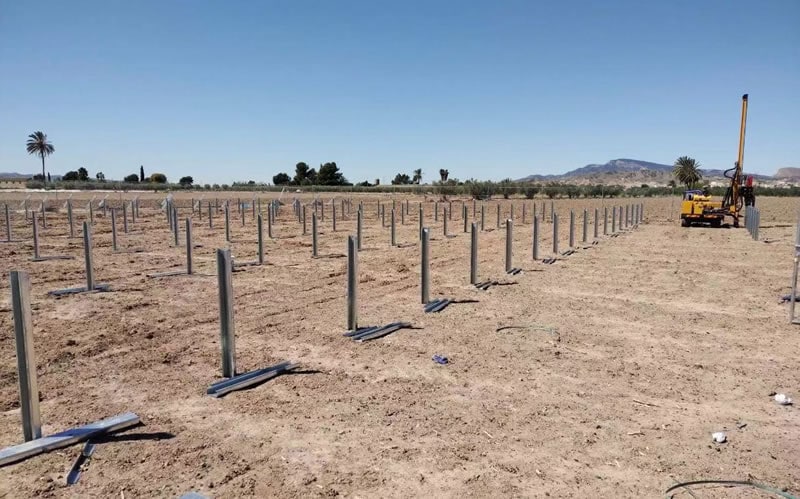
A structured sequence is critical for maintaining consistent output in solar farm construction. In large solar fields, the performance of pile drivers relies on a clear project working principle from start to finish.
Choosing the right starting point and maintaining continuous progress prevents repositioning, backtracking, and delays. This ensures efficient installation of each solar panel structure.
With a defined sequence, pile drivers operate at steady capacity, reducing idle time and keeping installation on track from the first pile to the final row.
Start Point Strategy: Where to Begin on a Large Solar Site
Choosing the right starting point improves overall workflow.
Key factors include:
- Access road location
- Site boundaries
- Terrain slope
- Environmental conditions
Starting in the wrong position reduces machine power efficiency and creates congestion.
Experienced operators evaluate ground conditions, soil type, and machine capacity before beginning.
This is especially important for photovoltaic pile drivers working in rocky ground or dense soils, where installation speed depends on proper sequencing.
Progress Control: Maintaining Consistent Pile Depth and Spacing
During installation, each solar pile must meet strict depth and spacing requirements. To ensure this, crews should verify that piles remain within the 3–6-meter range, thereby providing stable foundations for solar panels, even under high winds.
At the same time, operators continuously monitor alignment markers, machine hydraulic pressure, soil resistance, and the vertical positioning of piles.
If challenging ground conditions arise, adjustments to power, speed, or the vibratory hammer may be required to maintain performance.
Final Inspection, Correction, and Project Handover
The final stage involves a structured quality review to ensure all installed piles meet project requirements, industry standards, and regulatory compliance. Alignment, depth, and spacing are verified, along with the performance of installation equipment.
If issues are identified, corrections, such as realignment or reinstallation, must be completed before approval. Once all criteria are met, the piling phase is signed off, ensuring the solar project is ready for the next stage.
Quality Review Checklist: Alignment, Stability, and Depth Verification
Supervisors should evaluate each solar pile across the project using a structured checklist:
- Vertical alignment: Confirm that each pile is positioned at the correct angle and aligned with the planned layout to support the solar panels properly;
- Lateral stability: Apply manual load to check for movement. Limited displacement indicates adequate resistance, depending on soil conditions and overall ground response;
- Depth: Verify that each pile falls within the specified 3–6-meterrange to ensure proper anchoring.
Common Finish Errors: What to Catch Before Project Sign-Off
Common issues that arise during installation include misaligned piles that affect solar panel placement, insufficient depth that reduces stability, and incorrect spacing across rows.
In addition, unstable soil conditions may lead to weak performance, while inconsistent machine power can impact overall installation quality.
Addressing such issues before the sign-off helps reduce long-term costs, protect structural integrity, and ensure compliance with industry expectations.
FAQs
What does an effective solar pile installation workflow look like from start to finish?
An effective workflow includes layout preparation, coordinated deployment of pile drivers, continuous monitoring of piles, and structured final inspection. Each phase ensures consistent depth, alignment, and stability, allowing solar panels to be installed efficiently while meeting industry standards and overall project goals.
How should piling machine work be organized across a large solar farm site?
Work should follow a phased sequence across the job site, starting from a strategic point and progressing systematically. Operators must adapt equipment settings to changing soil conditions, maintain spacing accuracy, and ensure pile drivers operate continuously to maximize efficiency and meet project timelines.
A Disciplined Workflow Is What Keeps Solar Projects on Schedule

Successful solar farm construction depends on disciplined execution. In practice, accurate layout, structured sequencing, and thorough inspection enable pile drivers to operate at full capacity while controlling costs and maintaining efficiency.
Moreover, EVERSTAR’s solar piling machine performs most effectively when supported by workflow planning that considers ground conditions, machine capability, and the overall project scope. As demand for renewable energy continues to grow, efficient pile installation remains essential for building reliable infrastructure across the global industry.
Contact EVERSTAR for Solar Pile Driving and Pile Driver Solutions
If your next solar project demands reliable performance from pile drivers, EVERSTAR delivers advanced equipment engineered to operate efficiently across various types of soil and ground conditions, as well as challenging environmental conditions.
Contact EVERSTAR today to enhance construction efficiency, reduce labor and operational costs, and select the most suitable pile drivers for your application.

