
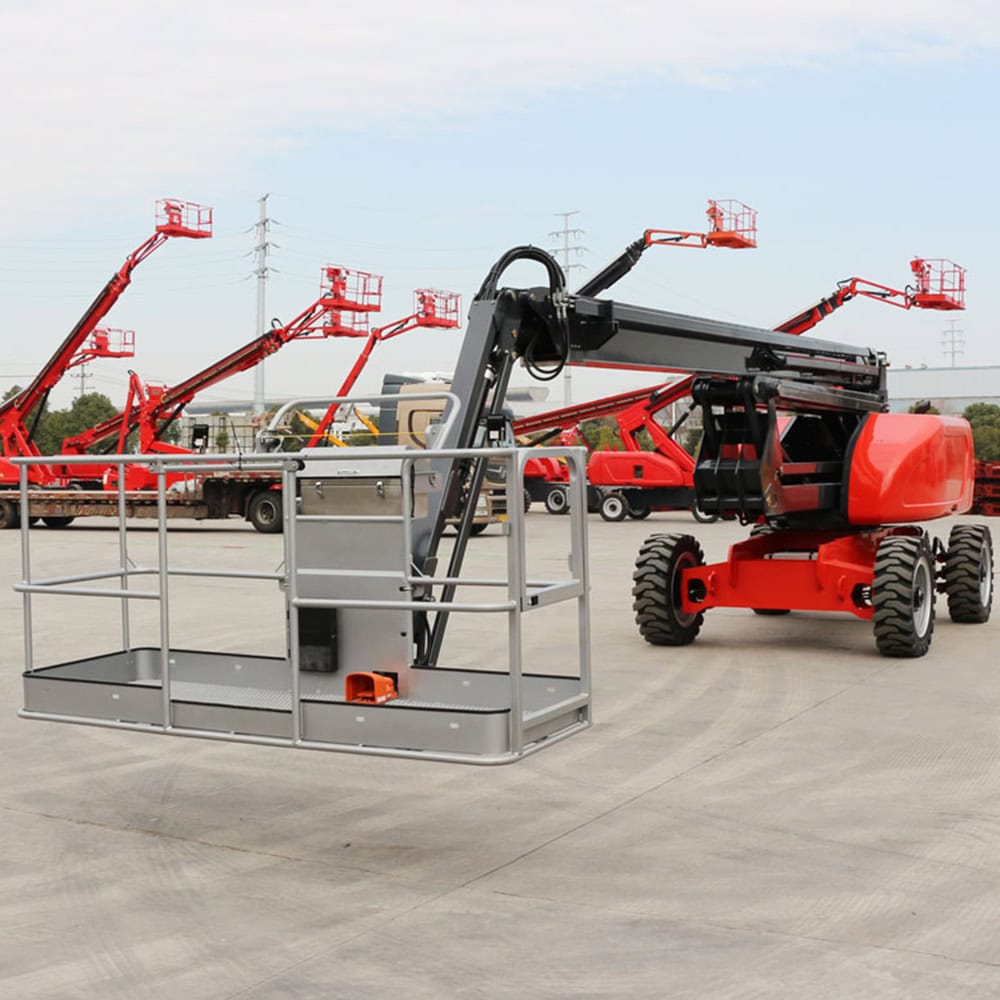
Key takeaways
- The EVERSTAR’s four wheel drive improves traction on soft, uneven ground.
- Diesel engine specs, including diesel powered, turbocharged options, must match site conditions.
- Always confirm ground bearing capacity before deploying a diesel boom lift or telescopic boom lift.
- Check wind speed and slope before elevating a telescopic boom lift or an articulating boom lift, especially at maximum platform height.
Boom lifts must combine working height, platform height, and horizontal outreach with strong traction on uneven terrain.
Soft ground, gravel, slopes, wet ground, and uneven terrain affect diesel boom lifts. Assess traction, platform capacity, and ground bearing capacity before use on construction sites.
4WD Systems: Drive Configuration and Rough Terrain Traction
How Drive Force Distribution Prevents Loss of Traction on Soft Ground?
Instead of relying on a single driven axle, four wheel drive spreads force across all four wheels, reducing wheel spin on soft ground, wet surfaces, and compacted gravel.
A two-wheel drive machine might have enough platform height and lift capacity for the job but could still struggle on non-compacted ground. EVERSTAR diesel boom lifts handle outdoor construction and maintenance well.
Before entering soft or wet ground, operators need to check 4WD engagement to ensure traction along the travel route.
One reason boom lifts and scissor lifts are chosen differently outdoors is that a boom lift, especially a telescopic boom lift or articulating boom lift, offers a wider working range and horizontal outreach, while the alternative mainly suits stable, sensitive surfaces or indoor use.
Oscillating Axle and Slope Tolerance: Stability Limits on Uneven Ground
An oscillating front axle lets the front wheels follow ground contour while staying in contact with the surface. That doesn’t mean the platform can extend on any slope.
Travel limits differ from operating limits: a boom lift can climb a slope stowed but needs far more level ground before it can be raised.
Before positioning an articulating boom lift or telescopic boom lift, it is necessary to confirm the manufacturer’s maximum operating slope. Platform height, boom configuration, and maximum working height must stay within limits, especially on horizontal rotation.
EVERSTAR diesel boom lifts must stay within the manufacturer’s slope tolerance during platform extension.
Engine Specifications for Remote and Demanding Jobsite Conditions
Diesel Engine Output, Altitude Performance, and Cold Start Reliability
A diesel engine supplies torque at low RPM for controlled movement and reliable hydraulic performance as the boom lift moves over difficult ground, an advantage for large scale construction and infrastructure projects.
At high altitudes, naturally aspirated diesel engines lose power, while turbocharged engines better hold platform capacity, supporting the working envelope on elevated construction or maintenance tasks.
Cold climates add another requirement: starting performance, operating temperature range, and specified fluids must match site conditions.
Another situation is when fuel tank capacity affects duty cycle. On remote sites without permanent fuel infrastructure, diesel boom lifts need enough runtime for long shifts and dual lift capacity when two occupants or heavier loads are required.
Diesel models handle demanding outdoor work, for you capacity of attend fuel efficiency under heavy loads.
Emission Standards: Stage V and EPA Tier 4 Compliance for Regulated Outdoor Zones
Diesel engine output is only part of the specification; it must also meet site regulations.
Diesel models can lose the job before they ever reach the site: an EU project calls for Stage V compliance, a US project calls for EPA Tier 4 Final,and outdoor construction or industrial work in a regulated zone won’t clear inspection without it.
Confirm emission standards before procurement; a boom lift meeting the required working height and platform capacity can be unsuitable if it fails local regulations.
This matters when comparing diesel-powered equipment with electric models for indoor and outdoor projects.
Ground Condition Assessment and Pre-Deployment Requirements

The ground conditions and the environment in your project are important to consider before selecting boom lifts. This information ensures that the boom lift has enough traction to maintain efficient operation during assessments.
Bearing Pressure Calculation and Outrigger Cribbing on Soft Construction Ground
Traction decides whether the boom lift reaches the deployment area; bearing capacity determines safe positioning.
Soft soil, saturated soil, and recently filled areas may not support heavy loads. Ground bearing pressure is calculated from the machine’s weight and load-bearing area.
The result is compared to the confirmed load-bearing capacity; where extra load distribution is needed, support or cribbing is used.
EVERSTAR also stresses checking bearing pressure at the site before extending an aerial platform.
The greater the working height and platform capacity, the more vital ground assessment becomes. A telescopic boom lift with extended horizontal outreach needs different deployment planning than compact equipment with more compact dimensions built for firm ground; an articulating boom lift close to a structure faces the same requirement.
Wind Speed Monitoring and Slope Limits for Outdoor Elevated Work
After the boom lift reaches its working position, conditions may change and wind becomes critical.
A boom lift should not extend when wind speed exceeds the manufacturer’s stated limit, and operators must monitor conditions during outdoor platform work.
Slope is the second check: the machine must stay within its approved operating slope before the platform is elevated.
At greater working height, these limits matter more. Unrestricted platform capacity does not override the manufacturer’s wind and slope restrictions.
The same rule applies to an articulated boom and telescopic boom: each boom configuration must stay within its approved working envelope. The boom lift pre-start inspection should cover jobsite conditions, proportional controls, and other machine controls and safety devices required under OSHA’s aerial work platform standards.
Choosing Between Articulating and Telescopic Boom Lift Diesel Models

Terrain capability is only part of selecting the right boom lift; the access path at height also matters.
An articulating boom lift uses an articulated boom to move around obstacles, ideal for tight spaces, confined spaces, and complex maintenance sites where direct access isn’t possible, well suited for industrial maintenance work.
A telescopic boom lift uses a straight telescopic boom for greater horizontal outreach, maximum working height, and high lift capacity. EVERSTAR models cover a wider range of heights, from 20 to 63 meters, with platform capacities up to 480 kg, more than an electric boom lift built for indoor floors.
For infrastructure work, a telescopic boom lift is well suited for high-reach access and a wide working envelope, while an articulating boom lift excels where obstacles or tight spaces demand flexible positioning.
When choosing the right boom lift, consider that performance depends on ground conditions and access geometry.
FAQs
How does 4WD improve diesel boom lift performance on soft or wet construction ground?
Four wheel drive distributes drive force across all four wheels, reducing wheel spin on soft fill, wet surfaces, compacted gravel, and uneven ground, helping the boom lift reach its deployment position. However, 4WD provides traction only, not ground bearing capacity for elevated operation.
What engine specifications should I confirm for a diesel boom lift on a remote or higher-elevation site?
Check altitude range, cold-start capability, fuel tank capacity, and emission compliance, and confirm if it fits your actual project. Turbocharged engines sustain performance better at altitude than naturally aspirated engines. Fuel capacity should also cover the duty cycle when refueling is difficult, or infrastructure is unavailable.
Contact EVERSTAR for Diesel Boom Lift Specifications
Contact EVERSTAR for diesel articulating boom lift and telescopic boom lift specifications, including four wheel drive configuration, working height, platform capacity, and horizontal outreach.

