
Key Takeaways
- Key differences between the two machine types come down to digging depth, breakout force, and whether a loader bucket ships standard.
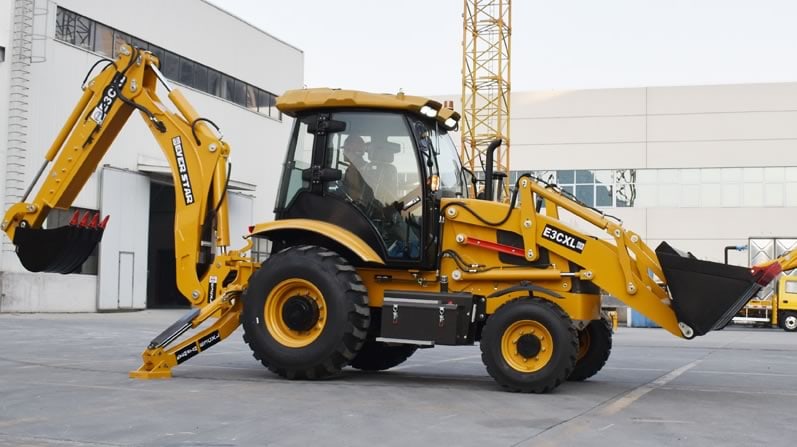
- EVERSTAR E3CXL reaches 5200 mm telescopic depth at 36 kN digging force; the E4CX reaches 5300 mm at 46 kN.
- Mini excavators can match or beat backhoe depth on some models but carry no front bucket for material handling.
- A road-legal backhoe loader skips the low-loader trailer every excavator move requires, cutting mobilization cost on multi-site work.
- Home, farm, light commercial jobs and landscaping projects, generally favor the backhoe loader; high-volume single-task excavation favors a dedicated excavator.
A contractor sizing a single-machine purchase for a mixed job site — some trenching, some material handling — usually lands on the same question: backhoe loader or excavator?
The backhoe loader vs excavator difference comes down to three numbers: digging depth, breakout force, and total job cost.
Beyond price, the significant differences show up in mobilization cost and whether one machine covers multiple tasks — the backhoe vs excavator call heavy equipment buyers often get wrong.
Consumers need to know whether one machine covers digging tasks and loading jobs, and whether it can move between spread out worksites without a trailer bill.
Digging Depth and Force: Quantified Performance by Model
EVERSTAR’s E3CXL and E4CX give heavy equipment professionals a road-mobile reference point, built to handle digging and front loading in one chassis, with published figures checked against a technical drawing. Sheer machine power isn’t the deciding factor — matching the spec sheet to the job is.
Backhoe Loader Depth and Force: EVERSTAR E3CXL and E4CX Figures
The EVERSTAR E3CXL reaches a telescopic digging depth of 5200 mm, delivers 36 kN of digging force through its rear digging arm, and rotates the backhoe arm 180°. The E4CX extends further: 5300 mm, 46 kN, and 190° of rotation.
Both figures cover the depth range most home, farm, and light commercial digging projects need, without the deep excavation reach the platform wasn’t built for.
Breakout force at the digging bucket separates a machine that breaks rough terrain and compacted soil from one limited to soft ground and loose materials; on soft terrain, the four-wheel stance holds traction. At 36–46 kN, the E3CXL and E4CX suit trenching, footing, and utility work rather than large scale construction or heavy duty digging beyond that force band.
Mini Excavator Depth Range Without Front Loading Capability
Mini excavators under 6t reach comparable depth on select models, and their 360° house rotation gives a complete circle of reach a backhoe loader’s fixed rear arm cannot match.
Their compact design suits tight lots, where task specificity matters: a mini excavator can dig holes and handle confined spaces better than a wheeled machine.
What compact excavators don’t carry is a front bucket. A job that also needs spoil moved, materials loaded onto a truck, or snow removal after a storm needs a second machine or a bolt-on attachment.
Total Job Cost: Mobilization, Attachment Count, and Idle Machines
Mobilization Cost: One Road-Legal Machine vs Trailer and Low-Loader
The EVERSTAR E3CXL travels at 40 km/h and the E4CX at 38 km/h, road-legal without a trailer.
Excavators, tracked and without road gearing, need a low-loader for every move, an operating cost on scattered, spread out worksites.
The U.S. Department of Transportation tracks the permitting burden oversize heavy loads place on local roads — the friction a self-mobile backhoe loader avoids.
For urban construction with tight access, that trip replaces a trailer booking and low-loader operator.
Combined Dig-and-Load Tasks: One Machine Cost vs Two-Machine Cost
Projects needing digging and loading, such as clearing a trench, then loading the spoil, then handling heavy materials at a stockpile, depend on the specific tasks on site, and may need a dedicated excavator plus a loader, or an excavator with different attachments swapped between tasks.
Various attachments close that gap, but each swap adds downtime that a backhoe loader’s built-in load bucket removes outright.
A backhoe loader completes both digging and loading with one multi purpose machine and operator, the core argument for choosing it over two idle-prone units, and its broader attachment options are one reason it suits various applications across mixed job types.
Crews that need to load materials onto a truck or handle occasional heavy lifting get that from the same front bucket, without a rental call. On combined-task sites, that can boost productivity by cutting idle time and attachment changes.
Choosing by Project Scale: Home, Small Commercial, and When the Excavator Wins
Home and Light Commercial Use: Backhoe Loader Covers Depth and Loading
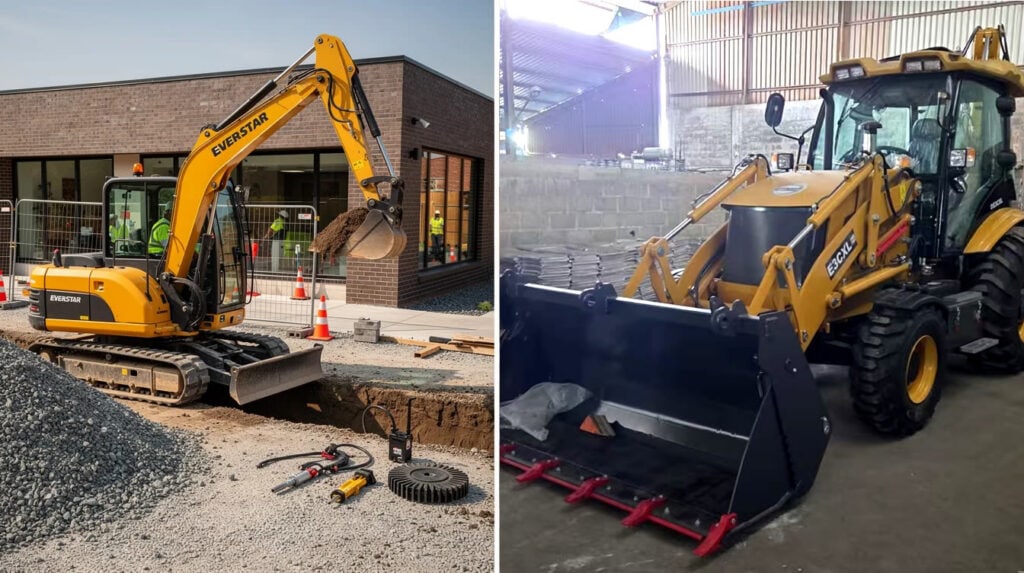
At 85 kW and 7300–8000 kg, the EVERSTAR E3CXL covers residential dig depths for footings, drainage, and utility trenching, then switches to front loading for spoil removal, with no second machine needed.
Homeowners and small contractors get a wider range of complete tasks from one unit, keeping operating costs down on landscaping projects and driveway work where a second machine would otherwise sit idle.
This is also where a backhoe vs. mini excavator comparison favors the loader: landscaping tasks, fence-line trenching, and light demolition projects rarely need a 360° swing, and they almost always need a bucket for loading.
Crews sometimes still call the combined unit a backhoe excavator, though the two serve different roles.
High-Volume Single-Task Excavation: When a Dedicated Excavator Is Justified
Large scale projects built around high-volume single-task excavation justify a dedicated excavator’s deeper reach and full 360° swing, and this contrast is one of the essential factors buyers weigh when they decide between a backhoe loader and an excavator for large-scale work.
Excavators are an excellent choice when large structures, heavy breaking, or mass earthmoving are the core requirement.
The entire machine can rotate 360 degrees, which saves time because the operator does not need to reposition as often.
Mining operations and major construction sites with dedicated loading crews fall into this category more often than home or farm work.
At 75 kW and 46 kN, the EVERSTAR E4CX covers most combined-task jobs below that threshold, including medium sized projects that mix excavation with material handling on the same day.
FAQs — EVERSTAR Backhoe Loaders
What is the main functional difference between a backhoe loader and an excavator?
A backhoe loader combines a rear digging arm with a front bucket on one road-legal chassis, so it handles digging and material handling without a second machine. An excavator offers a 360° swing and greater digging power for high-volume excavation but carries no loader bucket, so loading jobs need a separate machine or attachment.
Which EVERSTAR backhoe loader model suits combined dig and load tasks on commercial sites?
The EVERSTAR E4CX suits most combined-task commercial jobs, with 5300 mm digging depth, 46 kN digging force, and a 1.2 m³ load bucket at 75 kW. It covers medium sized projects and urban construction sites mixing excavation with loading, while the smaller E3CXL fits home and farm-scale work.
Depth, Force, and Total Job Cost Determine the Right Machine
Backhoe loaders combine front loading and rear excavation at published depth and force figures in one road-mobile machine, removing the mobilization cost and idle-machine risk of running two units.
Excavators justify their added cost only on high-volume jobs — deep trenching, mass excavation, mining operations — without a loading requirement.
EVERSTAR E3CXL and E4CX cover the backhoe loader profile for home, farm, and commercial work where digging and loading meet on site.
Contact EVERSTAR for Backhoe Loader Specifications and Model Selection Guidance
Consult EVERSTAR to compare E3CXL and E4CX depth, force, and load bucket specifications against your task list before committing to a machine type.
Our team can walk through mini excavator alternatives if your job site’s landscaping projects point toward a dedicated excavator.

