
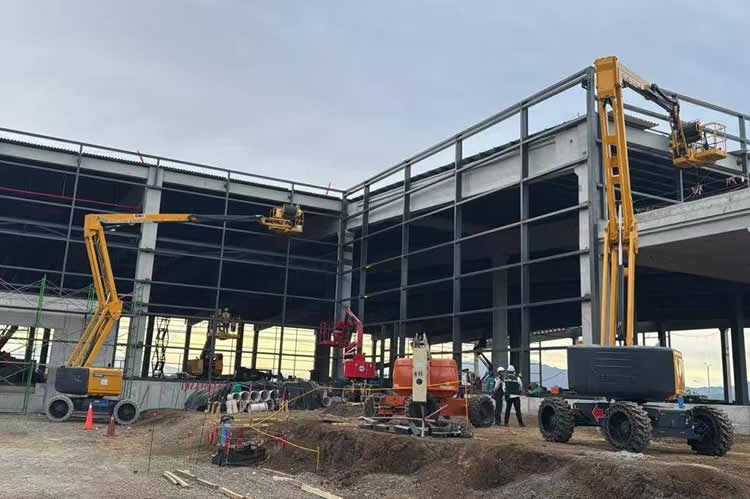
Key Takeaways
- Working height differs from platform height.
- Check horizontal reach at the required elevation.
- Articulating models are able to navigate obstacles.
- Platform capacity includes people, tools, and materials.
- Ground conditions affect machine selection and safe operation.
Choosing a boom lift for construction starts with the actual position of the work. Height matters, but it is only one part of the decision. Horizontal reach, obstacles, platform capacity, machine width, and ground conditions can all determine whether a boom lift is suitable for a construction site.
A machine may have enough maximum platform height and still fall short if it cannot reach across a setback or position the aerial platform around structural elements. Before mobilization, project engineers need to match these requirements to the specifications of the available models.
Calculating Required Working Height from Task Elevation: The Correct Method
Task Elevation vs. Working Height: Why These Are Not the Same Number
Working height is measured from the ground to the highest point an operator can reach. It is typically around 2 meters above platform height because it includes the operator’s reach.
If a task is 20 meters above ground, for example, the platform may need to reach approximately 18 meters. This corresponds to a boom lift with about 20 meters of working height.
Choosing a model rated exactly at the task elevation, however, can leave little usable range for positioning. Allow a practical height margin when defining the required specifications.
Both the platform height and operator reach therefore need to be considered. The required range of motion also affects the choice between a boom lift and scissor lift: scissor lifts are suited to primarily vertical access, while boom lifts provide horizontal reach when the work position is offset from the machine.
Outreach Angle and Height Trade-Off: How Horizontal Reach Reduces Maximum Height
A telescopic boom reaches its greatest height when positioned close to vertical. As it extends outward, the available vertical reach changes.
A model rated for a 47-meter working height, for example, may not provide that same height at the horizontal outreach required to clear a building setback.
The operator needs to confirm the working height available at the required outreach angle. This becomes especially important when excavation, materials, structures, or other obstacles prevent the machine from operating directly below the work area.
Horizontal reach and working height must therefore be evaluated together. A telescopic boom lift is designed for strong straight-line vertical and horizontal reach, making it especially useful where the machine has a clear path to the work position.
Boom Type Selection: Articulating vs. Telescopic for Construction Task Profiles

Diesel Articulating: When Knuckle Boom Geometry Is Required on Construction Sites
An articulating boom lift uses jointed boom sections that allow the platform to move up, over, and around obstacles.
EVERSTAR diesel articulating boom lift models cover working heights from approximately 16 to 47 meters. This geometry makes an articulating boom lift suitable for structural steel installation, facade work with setbacks, and mechanical or electrical work behind structural elements.
When a straight path is blocked, the articulating boom can provide access over parapets, around steelwork, or behind rebar cages. Articulation reduces unnecessary repositioning when several elevated areas can be reached from the same ground position.
This ability is useful on construction sites with tight spaces, confined spaces, or complex work areas. Machine width should also be checked before mobilization to confirm that the equipment can enter and operate in the available area.
Depending on the model, features such as four wheel drive and different steering modes can improve mobility on demanding construction sites.
Diesel Telescopic: Maximum Outreach for Open-Site and Bridge Work
A telescopic boom lift uses straight sections that extend outward. Its main advantage is long, direct horizontal outreach when the platform has a clear path to the work position.
EVERSTAR diesel telescopic boom models cover working heights from approximately 20 to 63 meters. This combination of maximum reach and platform height makes telescopic boom lifts suitable for open construction areas, elevated infrastructure, high-rise facade work, transmission line access, and bridge inspections.
Electric models are another option where emissions or noise are concerns. EVERSTAR electric articulating models cover working heights from approximately 12 to 28 meters. These electric models can be suitable for indoor construction, building access, and industrial maintenance where diesel operation is less practical.
The difference between these boom lift models comes down largely to how the machine needs to approach the work area: directly with a telescopic boom or around obstacles with an articulating boom.
Platform Load and Ground Condition: The Two Variables That Finalize Model Selection
Platform Load Capacity: Operators, Tools, and Material at Height
EVERSTAR boom lift models provide platform capacity from approximately 200 to 480 kg, depending on the machine. Two 90 kg operators carrying 50 kg of tools already require a minimum lift capacity of 230 kg.
PPE, tools, replacement components, and materials must also be included. Never calculate capacity from operators alone.
Working height, horizontal outreach, and platform capacity should be considered together because all three affect whether the aerial platform can perform the intended task.
Boom lift attachments may also add weight to the platform. Their weight and approved use should therefore be included when calculating the required capacity.
Rough Terrain Capability and Ground Bearing Pressure on Construction Sites
Construction sites can include compacted gravel, soft fill, or recently disturbed ground. A rough terrain machine with four wheel drive may provide better mobility, but traction does not mean the surface can safely support the equipment.
Ground capacity must support the machine. Before operation, site teams should consider machine weight, support area, and the bearing capacity of the ground.
Where outriggers are used, ground pressure and stabilizer planning become particularly important. The load transferred through the pads must remain within the capacity of the supporting surface, while soft or recently disturbed ground may require added support or cribbing.
A site assessment should also identify slopes, underground structures, overhead hazards, and obstacles that could affect deployment. These checks form part of the general boom lift safety process before operators begin work at height.
FAQs
How do I calculate the working height I need for a boom lift on a construction task?
Start with the task elevation above ground. Platform height is typically about 2 meters below working height because working height includes operator reach. Add a practical margin and confirm that the model provides the required height at the necessary horizontal outreach, rather than checking only its maximum platform height.
When should I choose a diesel articulating boom lift over a telescopic model on a construction site?
Choose an articulating boom lift when the platform must move around structural steel, parapets, equipment, or other obstacles. An articulating lift provides greater flexibility in confined spaces because its jointed boom can bend around obstructions. A telescopic boom lift is generally better when the work area has a clear approach and maximum horizontal reach is the main requirement. For lighter-duty work or jobs that move often, a towable boom is a portable option suited to frequent location changes.
Contact EVERSTAR for Boom Lift for Your Construction Tasks
Contact EVERSTAR to compare telescopic boom lift, articulating boom lift, and electric models for specific construction tasks. Working height, horizontal outreach, platform capacity, site access, and ground conditions can then be matched to the requirements of the job.

