
Key Takeaways
- Rated operating capacity (ROC) sorts skid steer sizes into small frame, medium frame, and large frame classes.
- A skid steer’s lift capacity, dump reach, and turning radius scale with size class, shifting further once an attachment is mounted.
- Compact track loaders add ground pressure advantages a wheeled loader can’t match on soft terrain.
- Pallet forks and other attachments shift weight distribution and cut into safe lift capacity.
- Site access and jobsite conditions, more than load volume, often decide the best fit across skid steer sizes.
A contractor who books the wrong skid steer size finds out fast: the bucket tips before it’s full, or the loader can’t clear the gate.
Rated operating capacity and machine width decide how much weight a skid steer can safely lift and where it can operate.
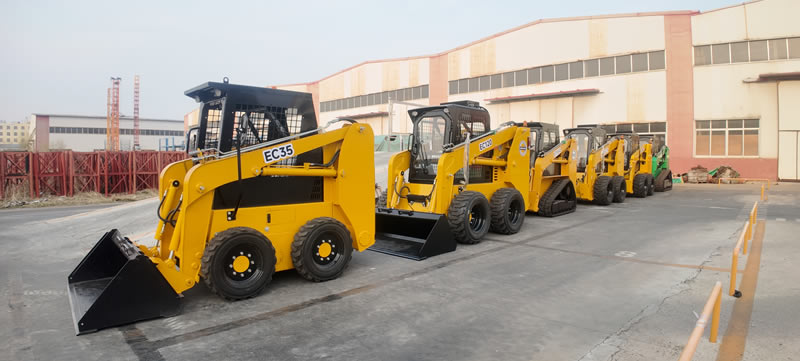
EVERSTAR’s skid steer loaders span compact to full-frame, in wheeled (EC25 to EC120) and tracked (ETS25 to ETS125) form, with rated loads from 380 to 1,500 kg.
Skid Steer Size Classes: How Rated Operating Capacity Defines the Categories
Every skid steer size class starts with rated operating capacity. Rated operating capacity ROC is the maximum weight a skid steer can carry and safely lift, set at roughly 50 percent of tipping load.
EVERSTAR manufactures skid steer models into small frame, mid-size, and full-frame categories using this ROC logic. Size class decides how a loader will lift, haul, and operate.
Small Frame Skid Steers: Compact Dimensions and Low-Load Applications
The EVERSTAR EC25 (wheeled) and ETS25 (tracked) sit at the small end: 380-400 kg rated load, 1,460-1,530 kg operating weight, and 920-1,070 mm width.
A Kubota 25 HP (18.2 kW) engine supplies engine power to both wheeled and compact track loader versions, meeting Euro V/EPA4 standards.
These compact skid steer loaders suit residential landscaping, garden access, and indoor work, trading lift capacity for the ability to operate in tight spaces.
Mid-Size to Full-Frame: Load Capacity and Dimension Progression
Move up a class, and the EC50-EC75 and ETS50-ETS65 models handle 700-1,050 kg on a 36.7-55 kW engine, with more powerful engines for daily construction.
At the top, the EC100-EC120 and ETS100-ETS125 full-frame loader models run 74.9-103 kW (Weichai engine) and carry 1,200-1,500 kg, with operating weights reaching 4,000-5,100 kg. Machine width grows to 2,124 mm on the EC120 and 2,134 mm on the ETS125, covering a full range of jobs on one platform.
Mini vs. Full-Size: Performance Differences That Matter on Site
Rated load isn’t the only number that changes across skid steer sizes. Lift height, dump reach, ground clearance, and turning radius shift with size class, changing operating speed and how a loader, wheeled or track loader, can operate.
Lift Height and Dump Reach: How Size Class Affects Material Placement
A vertical lift skid steer design keeps the bucket close to the loader through most of the arc, extending forward only near full height, which is why dump height and reach matter for a skid steer’s lift capacity. The EC25 reaches a 2,000 mm dump height with 441 mm of dump reach.
Full-frame skid steer models like the EC120 and ETS125 push that to a 2,450 mm dump height and 700-750 mm of dump reach, a higher lift capacity that can make all the difference on a busy site.
A vertical lift design pays off on demolition jobs, deciding whether a bucket clears a dump truck’s side.
Ground Clearance, Turning Radius, and Undercarriage: Compact Track Loaders vs. Wheeled Models
Small frame skid steers hold 140-145 mm of clearance and a 960-1,310 mm turning radius. Full-frame machines offer more clearance, at 200-205 mm, but a wider radius of 1,958-2,000 mm, the trade-off for higher lift capacity further up the range.
Every EVERSTAR size class ships as a wheeled skid steer loader or a compact track loader. A track loader spreads operating weight over a longer footprint, improving traction and safety where a wheeled model would spin, though it leans harder on hydraulics and costs more to maintain.
Matching Size Class to Project Requirements: A Decision Framework
Three key factors decide the right equipment for a job site: load volume per cycle, site access, and terrain. Weigh these key factors against the following tips before locking in a model.
Load Volume and Daily Task Profile: When Bigger Machines Pay Off
A full-frame skid steer, with 1,200-1,500 kg of rated operating capacity, pays for itself when the job requires heavy loads moved repeatedly on a demanding job site: large aggregate, bulk material, or demolition spoil, heavy loads calling for real heavy lifting and more weight per cycle.
Mid-size loaders, at 700-1,050 kg, cover most construction support, landscaping, and lighter loads without the operating cost of a full-frame machine, wheeled or built as a track loader. If the task is more digging than loading, EVERSTAR’s backhoe loader may be the best fit.
Attachments, Site Access, and Terrain: When Smaller Machines Are More Productive

Rated load figures assume a standard bucket, but various attachments change that math fast, and various attachments pose their own tipping risk. Pallet forks and hydraulic breakers add more weight at the coupler, shifting weight distribution forward and pushing a skid steer toward its tipping point. Check the maximum weight rating before mounting heavy attachments.
Compact models, at 920-1,070 mm wide, clear gate openings that full-frame machines (2,100+ mm wide) cannot pass, no matter how much lift capacity sits unused. Checking access and jobsite conditions against machine width confirms the right skid steer for the site and avoids equipment damage.
Limitations of Sizing by Rated Operating Capacity Alone
Rated operating capacity is a starting point, not the whole picture. ROC figures assume a standard bucket; adding a hydraulic breaker or forks shifts the load center and cuts a skid steer’s lift capacity before its tipping point.
Operating weights and lift capacity are tested on level, stable ground. Uneven terrain pulls the safe range below the rated figure, since gravity works against stability off flat ground.
Engine power and hydraulic system output affect operating speed, so two machines with identical operating capacity, power, and equipment can operate differently, model to model.
Specifications vary by market, undercarriage, and emissions configuration, so operators should confirm current figures and follow safe operation guidance near maximum rated capacity, per U.S. Department of Transportation equipment safety standards.
FAQs — Skid Steer Sizes
What is the rated operating capacity range across EVERSTAR’s skid steer size classes?
EVERSTAR’s skid steer loaders span 380-400 kg (small frame: EC25/ETS25) through 700-1,050 kg (mid-size: EC50-EC75/ETS50-ETS65) up to 1,200-1,500 kg (large frame: EC100-EC120/ETS100-ETS125). Rated operating capacity ROC sits at roughly 50 percent of tipping load.
How do machine width and turning radius affect skid steer site access by size class?
Compact models measure 920-1,070 mm wide with a 960-1,310 mm turning radius, fitting through gates and corridors, while full-frame loaders widen to 2,100+ mm with a 1,958-2,000 mm radius. Site access, not just load capacity, often decides the best fit for confined residential or urban job sites.
Contact EVERSTAR for Skid Steer Size and Specification Guidance
Browse EVERSTAR’s lineup at everstarmachinery.com for model comparisons. Not sure which frame size fits your project? EVERSTAR’s engineering team can walk through EC and ETS series specifications and attachment compatibility to match the right machine to your job.
Contact EVERSTAR here for a specification sheet.

